


Hot flashes, insomnia, mood disorders, headaches, vaginal dryness, and even weight gain: menopause is not limited to the end of menstrual periods.
It is a major hormonal transition period in every woman’s life. Beyond the symptoms often mentioned, one phenomenon often takes a back seat: the gradual decrease in collagen.
This essential structural protein found in bones, joints, and also the skin contributes to the strength, flexibility, and elasticity of tissues.
But why does this loss accelerate specifically at menopause ? And can collagen supplements really make up for this phenomenon? I explain it to you.
📚 Read also | The 14 best marine collagen supplements: the editors’ review
Why does menopause accelerate collagen loss?
Collagen production depends on cells called fibroblasts. However, their activity is influenced by female hormones, especially estrogen. In fact, these cells have hormone receptors that modulate their production activity.
I found several scientific studies that highlighted this link between estrogen and fibroblast activity.
However, menopause leads to a drop in estrogen levels: fibroblasts become less active, and collagen synthesis gradually slows down.
This study also showed that hormone treatments have the effect of increasing collagen production.
This gradual decline often results in:
- less elastic skin, drier, more wrinkled
- more fragile bones, with an increased risk of osteoporosis
- joint pain
Are collagen supplements really beneficial during menopause?
Modest effects on the skin and its elasticity
One solution to make up for this lack of natural collagen is to turn to dietary supplements. In powder or capsule form, these products promise effects on the skin and joints. But what do scientific studies actually show?
Several clinical studies have looked at the effects of hydrolyzed collagen peptides on the appearance of the skin.
The results of a scientific review of 19 studies involving 1,225 participants suggest that taking hydrolyzed collagen for 90 days is effective in slowing skin aging. Wrinkles would be reduced, and the skin would be more hydrated and more elastic.
Another review from 2023 reaches the same conclusions, although it notes that the results remain modest and variable depending on the studies.
In practice, the potential benefits observed in the studies include in particular:
- increased skin hydration
- slight improvement in elasticity
- decrease in wrinkle depth
However, I want to emphasize that collagen does not have a miraculous effect on the skin. After digestion, collagen peptides are broken down into shorter peptides and amino acids. Admittedly, they may stimulate certain pathways involved in collagen synthesis, but without any guarantee.
In other words, the effects probably do exist, but they remain far from the promises sometimes made by marketing, and are not specific to menopause.
A potential benefit for bones and joints
One of the major impacts of menopause is the progressive loss of bone density, always linked to the drop in estrogen. Yet collagen plays a key role in the integrity of the bone matrix.
Some scientific studies suggest that supplementation with collagen peptides could help maintain bone health in menopausal women.
I also found this clinical trial conducted with 131 menopausal women with osteopenia. After one year of supplementation with collagen peptides, the researchers observed an improvement in certain bone markers as well as an increase in bone mineral density.
At the joint level, there is currently no study specifically targeting menopausal women. However, several studies have looked at the effects of hydrolyzed collagen on osteoarthritis and joint pain.
A recent meta-analysis suggests, for example, that hydrolyzed collagen peptides could help reduce certain symptoms associated with knee osteoarthritis. While this does not allow us to draw direct conclusions for menopause, collagen supplementation remains promising for maintaining normal joint comfort.
It is important to keep things in perspective. Reliable data on collagen are still limited at present, and I would like to remind you that this supplement does not replace an appropriate diet, regular physical activity, or medical treatment when they are needed.
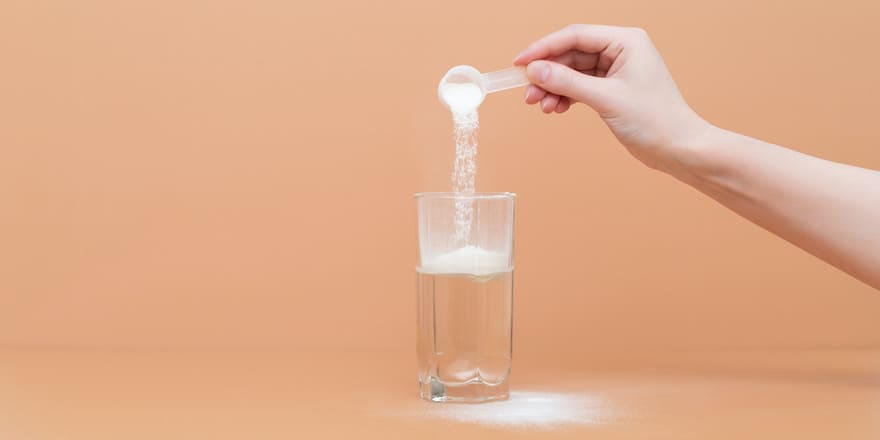
Collagen does not replace a comprehensive approach to menopause
Yes, some studies suggest that collagen supplementation may be beneficial for the skin, bone density, or joint comfort. But these observed benefits generally remain modest, and vary depending on the studies and the profiles.
Above all, tissue health during menopause does not depend on collagen alone. Physical activity, adequate protein intake, vitamin D, calcium, sleep, smoking, and even sun exposure also play a major role in skin and bone aging.
No dietary supplement can make up for all these changes associated with this major stage in a woman’s life.
I mainly recommend seeing collagen as a complementary support, and not as a miracle solution. Do not hesitate to seek support from a healthcare professional when necessary.
Scientific Sources and Studies
- Haczynski J, Tarkowski R, Jarzabek K, Slomczynska M, Wolczynski S, Magoffin DA, Jakowicki JA, Jakimiuk AJ. (2002) Human cultured skin fibroblasts express estrogen receptor alpha and beta.
- Calleja-Agius J, Brincat M. (2012) The effect of menopause on the skin and other connective tissues.
- de Miranda RB, Weimer P, Rossi RC. (2021) Effects of hydrolyzed collagen supplementation on skin aging: a systematic review and meta-analysis.
- Pu, S.-Y.; Huang, Y.-L.; Pu, C.-M.; Kang, Y.-N.; Hoang, K.D.; Chen, K.-H.; Chen, C. (2023) Effects of Oral Collagen for Skin Anti-Aging: A Systematic Review and Meta-Analysis.
- König, D.; Oesser, S.; Scharla, S.; Zdzieblik, D.; Gollhofer, A. (2018) Specific Collagen Peptides Improve Bone Mineral Density and Bone Markers in Postmenopausal Women : A Randomized Controlled Study.
- Simental-Mendía M, Ortega-Mata D, Acosta-Olivo CA, Simental-Mendía LE, Peña-Martínez VM, Vilchez-Cavazos F. (2025) Effect of collagen supplementation on knee osteoarthritis: an updated systematic review and meta-analysis of randomised controlled trials. Clin Exp Rheumatol.
