

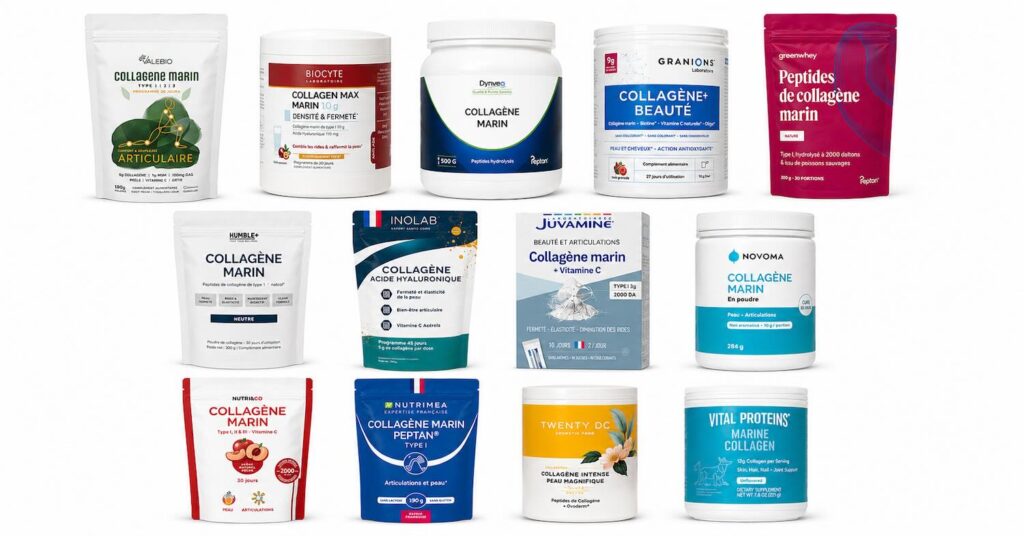
Our selection
Best marine collagen 🥇
> Marine Collagen Powder – Novoma
Best alternative
> Marine Collagen Hyaluronic Acid and Vitamin C – Inolab
Best value for money
> Marine Collagen Powder – Dynveo
Best marine collagen for joints
> Joint Marine Collagen – Valebio
Research on marine collagen has been growing rapidly in recent decades1. Fish has emerged as an optimal source for collagen extraction, both safe and sustainable.
The composition of marine collagen varies depending on aquatic species, but it has strong similarities with that of collagen from mammals. Many research teams are examining the benefits of collagen, and applications in the fields of health and cosmetics are multiplying.
Studies have explored the effects of an oral intake of marine collagen on skin elasticity and wrinkle reduction2, as well as on skin repair processes3. These results are encouraging, although the level of evidence still needs to be strengthened on a large scale.
Marine collagen products are multiplying on the market, so it is easy to get lost in the labels, with prices ranging from one to three times as much. The goal of this comparison is to help you see more clearly through a rating of each supplement.
📚 Read also | The guide to the best collagens
Best marine collagen: our opinion
Best marine collagen 🥇
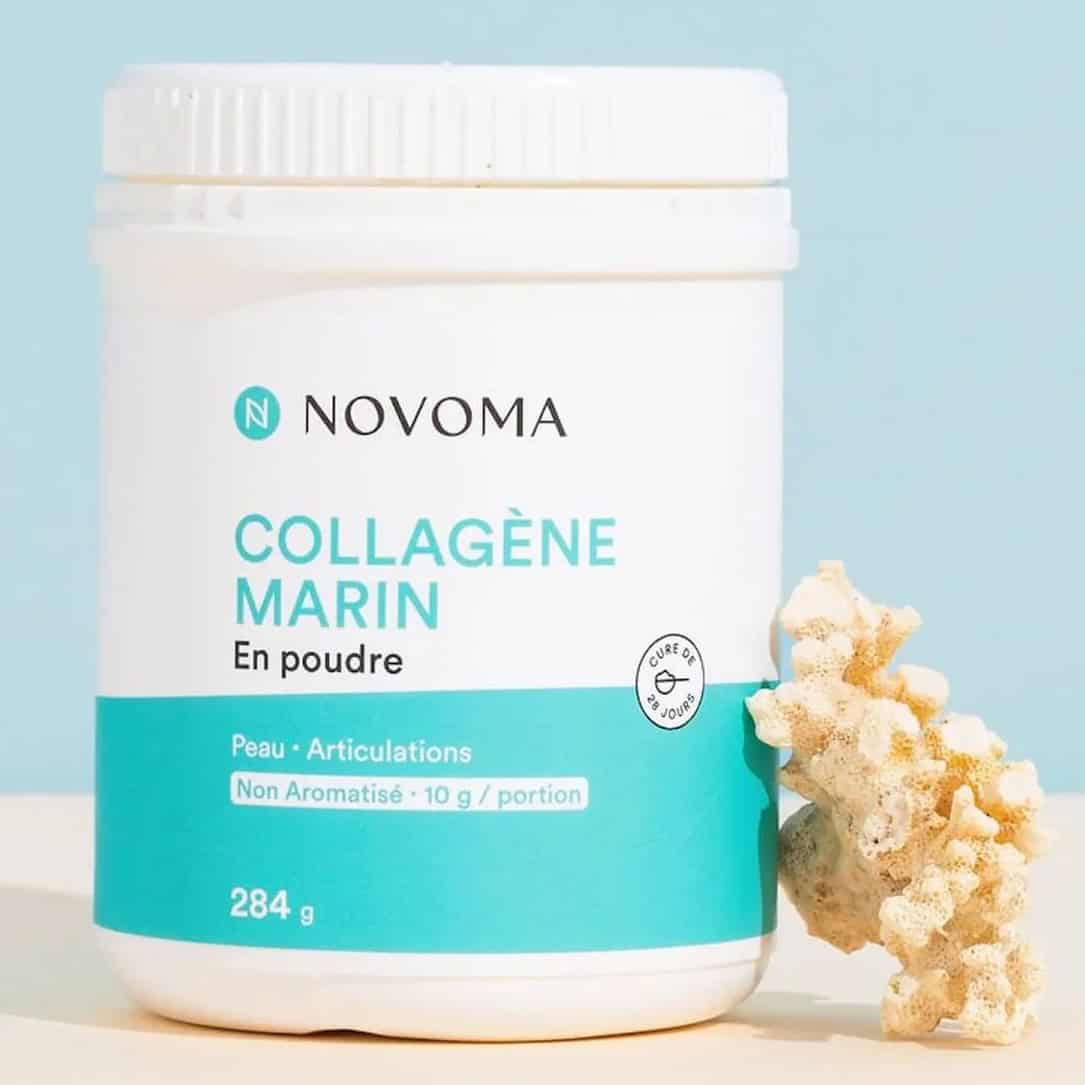
Novoma: 4.66/5
Formula : ★★★★★
Safety : ★★★★☆
Transparency : ★★★★★
Reputation : ★★★★★
Price : ★★★★☆
Benefits
- Complete daily dose of 10 g of patented Naticol® collagen (types I and III)
- Low molecular weight (2,000 daltons), a sign of good absorption
- Includes Quali®-C vitamin C (150 mg), which contributes to normal collagen formation
- Analysis certificate and label downloadable directly from the product page
- Neutral version with no additives: only two ingredients
- Sustainably sourced fish certified Friend of the Sea®, made in France
Disadvantages
- Only a 28-day jar: the monthly cost (≈ €35) remains in the upper average despite a good price per gram
- The exact species and fishing area are not specified on the page
Novoma is a French brand founded in 2012 in Toulouse, which has made a name for itself in the supplement market with a small range and streamlined formulas.
Its marine collagen powder checks almost every box on our criteria list. The daily dose of 10 g matches the amounts used in clinical studies conducted on Naticol®, Breton hydrolyzed peptides with a low molecular weight (2,000 daltons) sourced from sustainable fishing (Friend of the Sea® label). The formula is supplemented with 150 mg of Quali®-C vitamin C, which contributes to normal collagen formation.
The neutral version, which I selected for the comparison, contains only two ingredients: collagen and vitamin C. Three flavored versions (mango, caramel, red berries) are available for those who prefer them, with natural flavors and no sugar.
It is also the most transparent product in the panel: Novoma publishes the complete label and a downloadable analysis certificate on its product page, a practice that is still rare. Consumer reviews praise an odorless powder that dissolves easily, although some note a slight marine taste in the unflavored version.
Expect to pay €32.90 for the 284 g jar (28 days), or about €0.12 per gram of collagen: a competitive price for a fully dosed Naticol®.
Best alternative
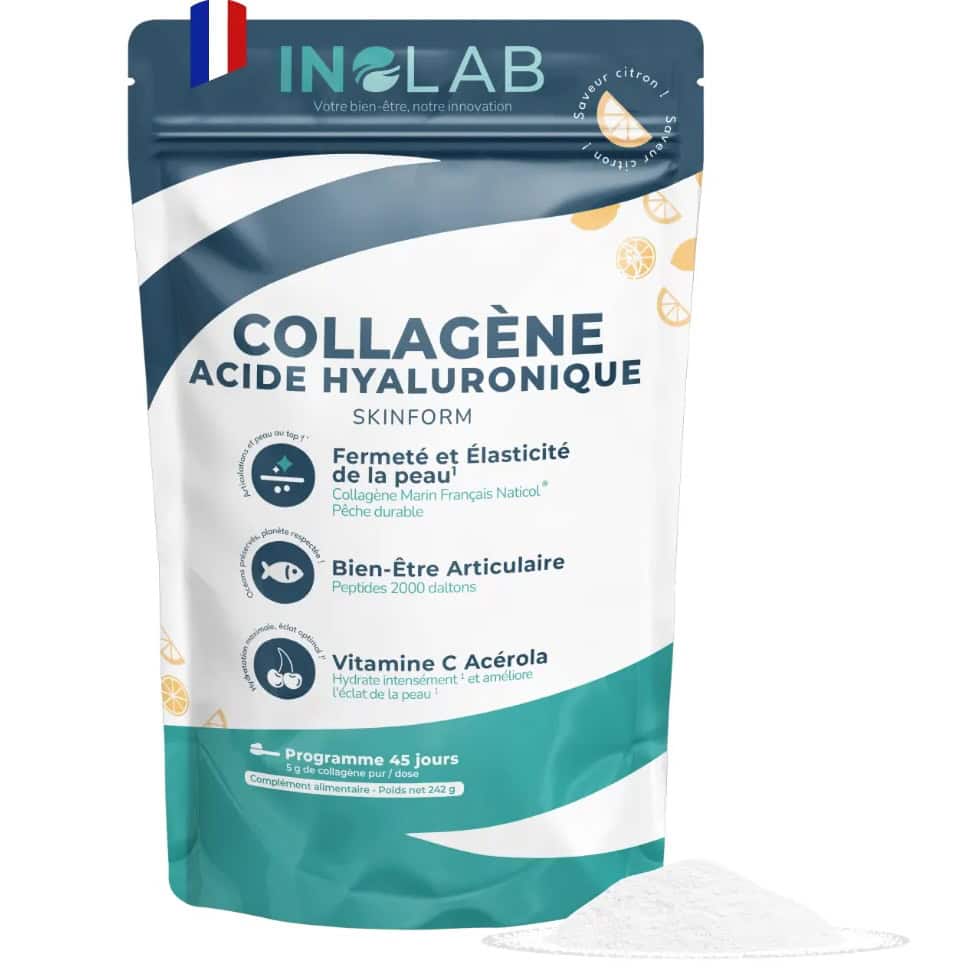
Inolab: 4.56/5
Form: ★★★★★
Safety: ★★★★☆
Transparency: ★★★★★
Reputation: ★★★★☆
Price: ★★★★☆
Benefits
- A skin-focused synergy: Naticol® + hyaluronic acid (50 mg) + organic acerola vitamin C
- Batch-specific certificates of analysis published on the product page (collagen and hyaluronic acid): exemplary transparency
- Low molecular weight (2,000 daltons), France-origin Naticol®, Friend of the Sea® certified
- 45 servings per jar: the lowest monthly cost in the comparison (≈ €17/month)
- 100% natural flavors, no sugar or sweetener
Disadvantages
- 5 g/day dose, twice as low as the leaders (Naticol® efficacy documented starting at 2.5 g, but below the highest-dosed protocols)
- No completely neutral version: four flavors to choose from (lemon, coffee, chocolate, red berries)
Inolab is a French laboratory founded in 2017, focusing on short formulas and complete transparency about its raw materials.
Skinform combines 5 g of French-origin Naticol® marine collagen (2,000 daltons, Friend of the Sea® sustainable fishing) with 50 mg of hyaluronic acid and an organic acerola extract providing vitamin C, which contributes to normal collagen formation: a synergy clearly geared toward skin beauty.
It is the product that impressed us the most in terms of transparency: Inolab publishes the batch analysis certificates directly on its product page, for both the collagen and the hyaluronic acid. No other brand in the panel goes that far.
The product is not available in a neutral version: you have to choose from four natural flavors (no sugar or sweeteners). We chose lemon, the simplest one, whose reviews (4.2/5 on Amazon) praise its pleasant taste — dissolving it in cold water, however, seems to take a bit of effort.
At €25.95 for 45 servings, the monthly cost drops to around €17: this is the most affordable option in our selection, at the price of a more modest daily dose (5 g) than the 10 g references.
Best value for money
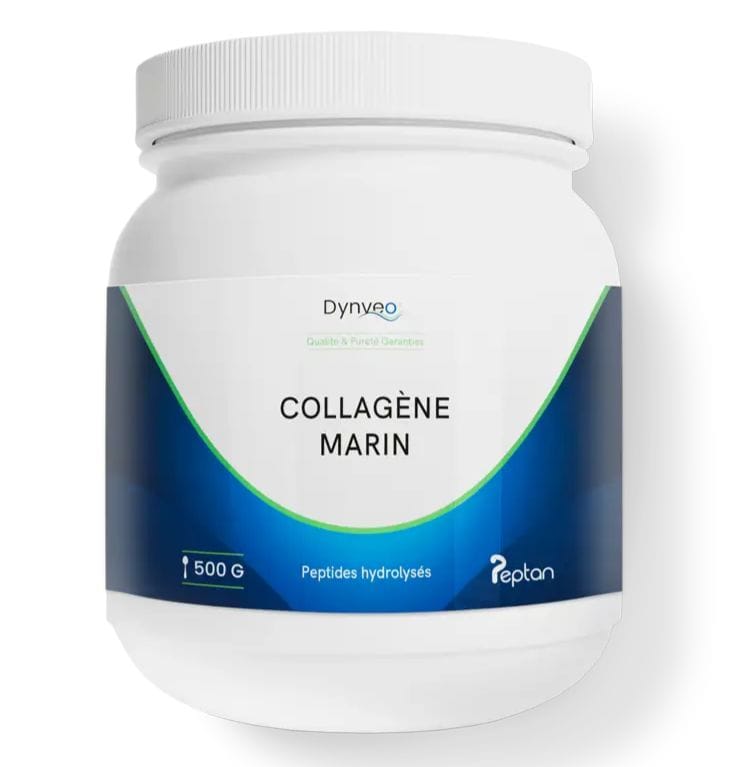
Dynveo: 4.58/5
Form: ★★★★★
Safety: ★★★★☆
Transparency: ★★★★★
Reputation: ★★★★☆
Price: ★★★★☆
Benefits
- 100% Peptan® peptides, the global benchmark for hydrolyzed collagen: zero additives
- Wild white fish from the North Atlantic, certified sustainable MSC® fishing
- Low molecular weight (< 2,000 daltons)
- The lowest price per gram in the comparison (≈ €0.08/g)
- Large 500 g size (48 days), 100% French production chain
Disadvantages
- No complementary active ingredient: no vitamin C, to be added separately
- Sold only directly (no Amazon distribution or pharmacy sales)
- Analyses (heavy metals, antibiotics) claimed but batch certificates not published on the product page
Dynveo is a French laboratory founded in 2010, known to insiders for its “clean label” positioning: pure active ingredients, with no excipients, and full traceability.
Its marine collagen is the most minimalist product in our selection: 100% Peptan® type I peptides, with no other ingredients. This global benchmark for hydrolyzed collagen, produced in France, is obtained from the skins of wild white fish caught in the North Atlantic (MSC® certified fisheries), with a molecular weight below 2,000 daltons.
The included scoop allows a daily intake of 10.4 g, in line with the dosages used in clinical studies on Peptan®. The downside of this minimalism: there is no vitamin C in the formula, even though it contributes to normal collagen formation — you will need to get it elsewhere.
The 500 g jar priced at €39.90 covers 48 days, or about €0.08 per gram of collagen and less than €25 per month: by far, it offers the best value for money in the comparison. The brand claims systematic testing (heavy metals, antibiotics, hormones); we simply regret that batch certificates are not published directly on the product page.
Best marine collagen for joints
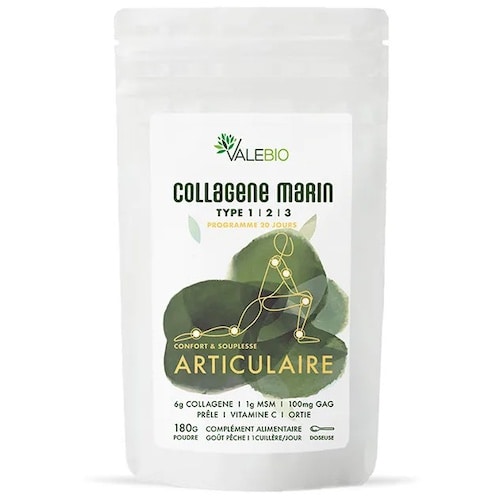
Valebio : 4.13/5
Formula : ★★★★★
Security : ★★★☆☆
Transparency : ★★★★★
Reputation : ★★★★☆
Price : ★★☆☆☆
Benefits
- Very comprehensive joint formula: 3 types of collagen (I, II, III) + MSM (1 g) + glycosaminoglycans + horsetail + nettle + vitamin C
- The lowest molecular weight in the comparison (1,500 daltons)
- Recognized-quality Naticol® collagen, certified sustainable MSC® fishing, made in France
Disadvantages
- The presence of sucralose (intense sweetener), coloring, and flavorings: the most additive-heavy list in my selection
- The cost per gram of collagen is a bit high, even if the complementary active ingredients partly justify it
- Only one flavor (peach), no unflavored version
Founded in 2016, Valebio is a French nutraceutical brand that claims quality, expertise, and respect for the environment.
Its Joint Collagen remains the most comprehensive formula on the market for targeting joints: each 6 g scoop provides the three types of collagen most abundant in the body (5.9 g of types I and III, 100 mg of type II), hydrolyzed to 1,500 daltons — the lowest molecular weight in my selection — plus 1 g of MSM, glycosaminoglycans, horsetail, nettle, and 80 mg of vitamin C, which helps maintain cartilage.
The manufacturer is Naticol®, whose reputation is well established, and the fish come from certified MSC® sustainable fisheries. The recommended protocol is original: 20 days of use followed by 10 days off, with the 180 g jar covering 30 servings.
Our main criticism concerns the ingredient list of the only version (peach): sucralose, beta-carotene coloring, acidifier, and flavorings. It’s a shame for an otherwise demanding formula, and it weighs on its Safety score.
At €39.90 per jar, the cost works out to about €0.22 per gram of collagen: relatively high, which the richness of the joint formula partly justifies.
The other marine collagens in our selection
Aroma-Zone – Marine Collagen Powder
The French brand founded in 1999 applies its usual recipe to collagen: a raw active ingredient at the lowest possible price. Its 100% pure powder (2,000 daltons, over 99% purity) contains absolutely no additives, comes from Friend of the Sea® certified aquaculture, and is made in France, for around €0.09 per gram — one of the lowest prices in the comparison. However, it lacks an identified patented manufacturer (no Naticol® or Peptan®), published analysis certificates, and a complementary active ingredient like vitamin C: an excellent entry-level collagen, more than an expert formula.
Biocyte – Collagen Max Marine PRO-HCOL®
The French nutricosmetics specialist (2006) offers a PRO-HCOL® marine formula: 10 g of type I collagen (2,000 daltons) and 110 mg of hyaluronic acid per serving. The rest is a bit disappointing: no neutral version (Passion or Cocoa only), a loaded ingredients list (maltodextrin, flavorings, coloring, steviol glycosides), no disclosed fish origin, no fishing label — and above all a price of €60.50 for a 20-day jar, or more than €90 per month: by far the most expensive in the comparison.
Granions – Collagen+ Beauty
An iconic pharmacy brand since 1948, Granions delivers one of the most comprehensive formulas in the comparison: its pomegranate-flavored powder provides 9 g of patented marine collagen per day, along with hyaluronic acid, biotin (vitamin B8), acerola vitamin C — which contributes to normal collagen formation — and evening primrose oil. At €26.90 for 27 servings, it is also one of the best value options per gram in the selection (≈ €0.10/g), backed by a well-established, highly rated brand (4.3/5 on Amazon). The formula remains relatively clean — pomegranate flavoring, modified starch as a carrier, and beetroot powder as a natural colorant, with no sweetener — but the product is only available in a flavored version and does not specify where it is manufactured, which keeps it off the podium for transparency.
GreenWhey – Peptan® Marine Collagen Peptides
This French sports nutrition brand (2015) applies its protein expertise to a streamlined collagen formula: the Nature version is made of 100% Peptan® (2,000 daltons), with each 10 g serving providing 9 g of peptides sourced from certified MSC® and Friend of the Sea® wild fish, all manufactured in France. At €34.95 for 300 g (≈ €0.13/g), the value for money is solid. It lacks an additional active ingredient (no vitamin C in the Nature version) and batch analysis certificates, which keeps it from reaching the podium.
Humble+ – Marine Beauty Collagen (PurCollagène)
French brand launched in 2019 and entirely dedicated to collagen, Humble+ offers a minimalist plain version: 5 g of Naticol® per serving, with no other ingredient, in a generous 300 g format covering two months (€36.90, ≈ €0.12/g). The farms are said to be certified and the hydrolysis is carried out in France, but no third-party label is displayed; heavy metal tests are claimed “for every batch” with no published certificates. A moderate dose and a formula without vitamin C keep it in the middle of the pack, despite good consumer feedback (4.3/5 on Amazon).
Juvamine – Marine Collagen 3000 mg
The mass-market brand (1987) has seriously revamped its formula: its sticks now contain Naticol® from France, certified Friend of the Sea®, with vitamin C and no flavors or sweeteners — the old recipe is a thing of the past. Two major limits remain: a dosage of 3 g per day, below market references, and a box of 20 sticks (10 days) which increases the actual cost: around €0.43 per gram of collagen.
Nutri&Co – Marine Collagen
Our former number 1 remains a very safe bet, just off the podium. The Aix-based brand (2017) is the only one to combine two patented collagens: 5 g of Naticol® (types I and III, MSC®-certified Alaska pollock) and 500 mg of Cartidyss® (type II, from rays off the Breton coast), with 24 mg of vitamin C. Traceability is exemplary — species, regions, and French processing sites all published — and the formula is free of sugars and sweeteners. What costs it the top spot: a dose of 5.5 g per day and a cost of around €0.19 per gram, among the highest in the selection at €30.90 per month.
Nutrimea – Marine Collagen Powder Peptan®
The French laboratory (2012) ticks the technical boxes: 10 g of Peptan® type I (2,000 daltons) per day, vitamin C, and — a rare occurrence — four analysis documents published directly on the product page (DGAL certificate, microbiological analyses, Peptan® technical sheet). Two reservations keep it out of the selection: the product comes only in raspberry flavor, sweetened with sucralose, and the 190 g jar covers only 19 days at the full dose (€26.90, ≈ €0.14/g), which complicates long-term use.
Twenty DC – Beautiful Skin Collagen
The young French brand (2021) specializing in collagen has made major progress since our last test: the price has dropped from €52.90 to €39.90 for 280 g, and the site now publishes the molecular weight (< 2,000 daltons), the “made in France” claim, and the sustainable aquaculture origin. The unflavored version is limited to two ingredients: 9.85 g of marine collagen and Ovoderm® (egg shell membrane). One blind spot remains, which costs it points in our scoring: the manufacturer of the marine collagen is not disclosed.
Vital Proteins – Marine Collagen
The American brand from the Nestlé group (2014), backed by powerful marketing, emphasizes purity: a single ingredient, wild-caught Alaskan cod collagen — the best origin traceability in the panel. The rest is less compelling: a molecular weight simply stated as “< 5,000 daltons,” well above competitors’ 2,000, no vitamin C, no third-party fishing label, limited technical transparency, and a 221 g format that covers only 18 days at a 12 g serving (€42). A lot of brand recognition for a somewhat underwhelming technical sheet.
Methodology
The product rankings are established by our editorial team, based on objective criteria. The methodology and FAQ were prepared by Géraldine Dubois, a doctor specializing in nutrition, who acts as a scientific expert. Product data was collected in June 2026 on brand websites. Prices and characteristics may change.
We analyzed 14 marine collagen powder supplements among the best-selling online in France.
Each product is rated from 1 to 5 on a grid of criteria divided into 5 weighted dimensions: Formula (35%), Quality & Safety (25%), Transparency (15%), Reputation (15%), and Price (10%).
Important rule: for each brand, the plain version is assessed when available; otherwise, the least additive-laden version is used. Available flavors are descriptive information, not a basis for scoring.
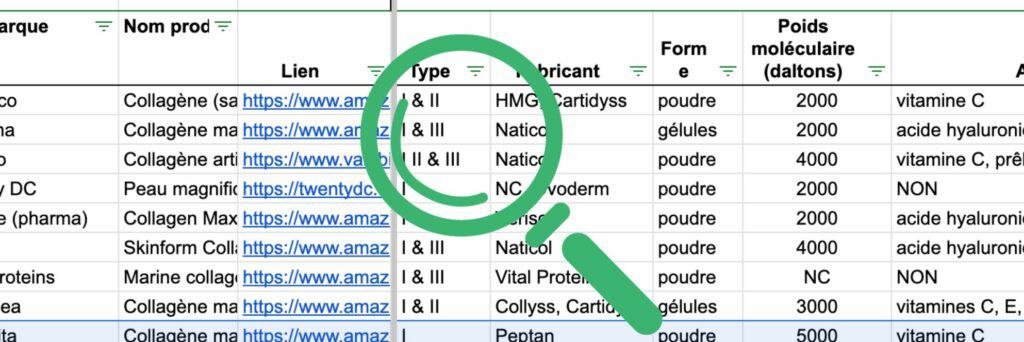
→ Access our full comparison table here (Google Sheet)
1. Formula
The type of collagen
Collagen types I, II, and III correspond to the main forms found in the tissues of the human body.
The entire selection contains at least type I collagen, which is abundant in fish skin6.
Some supplements also contain some type II collagen, usually derived from cartilage and bones, or type III collagen, which also comes from the skin.
The daily dosage
Clinical studies conducted on collagen peptides most often use doses ranging from 2.5 to 10 g per day. I recommend noting the actual amount of collagen provided by each brand’s recommended daily dose — which here ranges from 3 to 12 g — and favoring products with the highest doses.
Molecular weight and bioavailability
For collagen to be properly used by the body, it must be ingested in a fragmented form. To achieve this, the process that breaks it down into small pieces is called hydrolysis. This results in a format called collagen peptides, characterized by their size in daltons (or molecular weight). In short, the lower the molecular weight, the better these peptides are absorbed.
Manufacturer patent
The hydrolysis method must be gentle enough and free of harmful solvents to preserve all the qualities of collagen peptides. Manufacturers specializing in the extraction of marine collagen must guarantee the process through a patent. Several quality labels are known, such as Naticol®, Peptan®, Cartidyss®, or even Collyss®.
Other active ingredients
The formula of the selected collagens is combined with other complementary substances. I recommended noting their presence and nature, with special attention to vitamin C: it is the only substance benefiting from an authorized claim in Europe related to collagen (it “contributes to normal collagen formation”).
2. Quality & safety
Regarding the safety of the different marine collagens analyzed, the following should be considered:
Fish origin
It seems important to ensure the origin of the raw material (the fish) from which the collagen is extracted.
Some brands do not always display it, and the information is sometimes lacking in clarity. This lack of information is now directly penalized in the rating: brands that declare the species and fishing area receive the best score.
Sustainable fishing labels
Beyond generic claims (“responsible fishing”, “sustainable aquaculture”), you need to verify the presence of certifications issued by third-party organizations, such as MSC® or Friend of the Sea®.
The presence of additives and sweeteners
I recommended analyzing the ingredient list of each product — in its compared, neutral, or least additive-laden version — in order to identify the presence of additive substances that can affect a product’s quality. This is the case, for example, with anti-caking agents (magnesium stearate, silicon dioxide), colorants, intense sweeteners (sucralose), or certain artificial flavors. This is an important aspect to consider.
Contaminant testing
Marine raw materials can expose consumers to contaminants such as heavy metals. It is important to distinguish between brands that publish their test certificates online, batch by batch, and those that claim to conduct checks without making them available for consultation — and those that say nothing about it.
3. Transparency
Published technical information
Molecular weight, peptide manufacturer, origin of the raw material: you need to check that this essential information is available directly on the product page, without having to contact customer service.
The declared place of manufacture
A clear statement of the place where the finished product is manufactured (France, the European Union, or outside the EU) is valued. Its complete absence is penalized: consumers must be able to know where what they consume is made.
4. Reputation
To assess the brand’s reputation, one can take into account the company’s longevity.
It is also necessary to look at customer reviews on Amazon (when the products are available on this platform — their absence not being penalized).
5. Price
Formats vary widely from one brand to another: jars of 180 to 500 g, daily doses of 3 to 12 g. To compare like with like, I recommend calculating a single indicator: the cost per gram of collagen actually provided (price of the jar divided by the daily dose multiplied by the number of days covered).
This indicator varies fivefold across the selection, from about €0.08 to more than €0.40 per gram. The prices used are those displayed on the official websites of the brands on the update date of the comparison.
Frequently Asked Questions (FAQ)
Which is the best collagen: marine or bovine?
The emergence of more recent studies on marine collagen tends to show that it has very favorable biological qualities. In addition, extracting marine collagen makes it possible to use and add value to by-products from the fish processing industry that would otherwise be lost. Moreover, marine collagen has advantages over bovine collagen: lower risk of disease transmission and no religious considerations. Nevertheless, research teams do not agree on the effectiveness of one over the other. Especially since several factors can affect the way collagen is absorbed.
How long does a marine collagen treatment last?
There are relatively few studies using exclusively marine collagen in humans. The effects are mainly demonstrated in animals. It is therefore difficult to provide a specific answer regarding this type of collagen. The scientific literature review mostly includes studies on the intake of collagen peptides from several sources. In this case, the average duration is 8 to 24 weeks depending on the subject studied (skin, joints, etc.). Given the gradual decline in collagen production with age, it seems relevant to consider regular courses starting at age 25 to 30. However, there are no official recommendations at this time.
Where can you find marine collagen in your diet?
Marine organisms contain bioactive substances that are increasingly used in the health and cosmetics sectors. The skin and bones of fish are richer in collagen than the flesh. Sardines, of which several parts are consumed, are an excellent source of collagen. Note that squid, jellyfish, sponges, and other invertebrates are also abundant sources of collagen. Recent studies focus on both to determine the characteristics of their collagen.
Where can you buy marine collagen?
Many dietary supplement brands offer marine collagen. The vast majority of the selected brands are known for their quality. Ideally, you should order directly from the brand’s website. The more detail it provides about its product, the stronger the guarantee of reliability: the origin of the raw material, the extraction conditions (manufacturer’s patent), the collagen concentration per dose. Some brands are also sold in pharmacies and parapharmacies. Even though most online pharmacy websites are trustworthy and reliable, there are unfortunately a few exceptions.
Does marine collagen pose a risk or have side effects?
Numerous studies involving the intake of marine collagen do not show any obvious danger. Collagen treatments are, in most cases, safe and well tolerated. However, rare digestive side effects have been reported: bloating, nausea, or intestinal cramps. People who are allergic to fish should avoid taking marine collagen. Likewise, the risk of overdose is very low because excess collagen is easily eliminated. Nevertheless, it is always recommended to follow the indicated doses.
What does marine collagen taste like?
The challenge for brands that produce this collagen lies more in minimizing the fishy taste, which most consumers consider unpleasant. Consumer reviews are a good indicator of this. Flavored versions of collagen powders can mask the taste, but in that case, be sure to check the nature of the additives present.
Bibliography
1. Salvatore L, Gallo N, Natali ML, et al. Marine collagen and its derivatives: Versatile and sustainable bio-resources for healthcare. Mater Sci Eng C. 2020;113:110963.
2. Lee M, Kim E, Ahn H, Son S, Lee H. Oral intake of collagen peptide NS improves hydration, elasticity, desquamation, and wrinkling in human skin: a randomized, double-blinded, placebo-controlled study. Food Funct. 2023;14(7):3196-3207.
3. Yang F, Zhao D, Zhang K, et al. Oral delivery of marine shellfish supramolecule peptides for skin wound healing. Colloids Surf B Biointerfaces. 2022;216:112592.
4. Khatri M, Naughton RJ, Clifford T, Harper LD, Corr L. The effects of collagen peptide supplementation on body composition, collagen synthesis, and recovery from joint injury and exercise: a systematic review. Amino Acids. 2021;53(10):1493-1506.
5. Lim YS, Ok YJ, Hwang SY, Kwak JY, Yoon S. Marine Collagen as A Promising Biomaterial for Biomedical Applications. Mar Drugs. 2019;17(8):467.
6. León-López A, Morales-Peñaloza A, Martínez-Juárez VM, Vargas-Torres A, Zeugolis DI, Aguirre-Álvarez G. Hydrolyzed Collagen—Sources and Applications. Molecules. 2019;24(22):4031.
7. Choi FD, Sung CT, Juhasz MLW, Mesinkovsk NA. Oral Collagen Supplementation: A Systematic Review of Dermatological Applications. J Drugs Dermatol JDD. 2019;18(1):9-16.
8. Bhagwat PK, Dandge PB. Isolation, characterization and valorizable applications of fish scale collagen in food and agriculture industries. Biocatal Agric Biotechnol. 2016;7:234-240.
9. Coppola D, Oliviero M, Vitale GA, et al. Marine Collagen from Alternative and Sustainable Sources: Extraction, Processing and Applications. Mar Drugs. 2020;18(4):214.
