


Collagen is an essential protein for the human body. Bones, muscles, blood vessels, joints, skin, and tendons all have an extracellular matrix rich in collagen.
Its role: to hold tissues together by acting like a glue, and to provide them with strength and elasticity.
However, with aging, our collagen synthesis decreases. This natural decline has consequences we all notice, such as the appearance of wrinkles, loss of skin elasticity, and joint pain.
Taking dietary supplements to minimize these effects can be an interesting option. And while marine collagen supplements are often touted for their benefits, there is another type of collagen on the market: bovine collagen.
📚 Read also | A doctor tested 15 collagen brands, here is his selection
How is bovine collagen manufactured?
A product derived from the food industry
Bovine collagen comes from by-products of the meat industry. The bones, skins, and tendons of cows, which are considered “waste” of the food industry, are recovered to make supplements.
The manufacturing process
The cleaned and degreased raw materials are then subjected to a chemical or enzymatic treatment to isolate and recover the collagen molecules.
Once extracted and purified, they undergo further processing to convert native collagen (the whole molecule) into collagen peptides, which are more easily absorbed by the body.
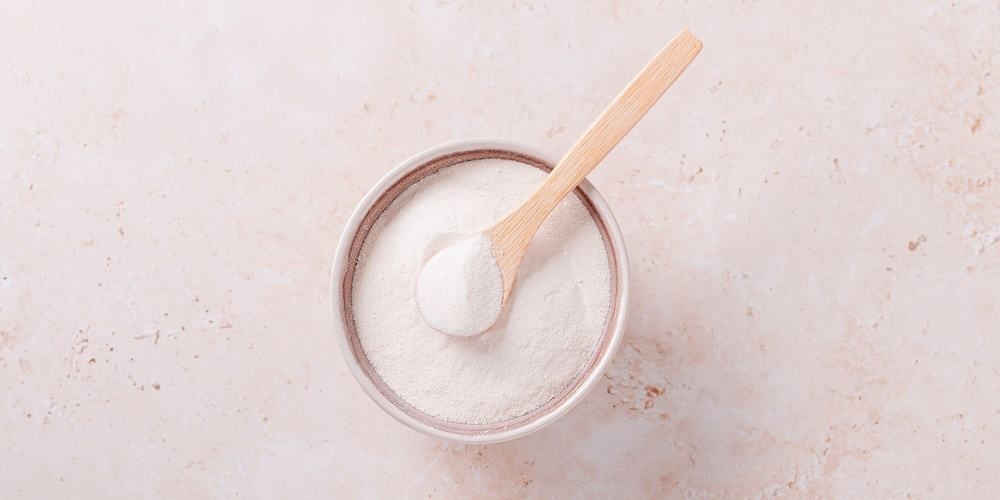
Finally, to obtain the powder we are familiar with and that is used in supplements, the whole material undergoes a drying phase.
A neutral taste
Don’t worry, this animal-derived powdered product does not taste like meat at all. When it is plain, bovine collagen has a neutral taste and can be mixed into your drinks. Some brands also add flavors (peach, lemon, etc.) to make the experience more pleasant.
📚 Also read | A doctor’s tips for choosing the best marine collagens
What is its molecular composition?
Bovine collagen has a composition and structure relatively close to that found in humans, and which is described in this study.
Supplements of bovine origin generally contain type I and type III collagen. However, the type of collagen matters little, since they are presented as peptides and therefore no longer have a characteristic structure.
In terms of amino acids, glycine, proline, and hydroxyproline are the main ones. I also noted this study comparing bovine and marine collagen.
Even though the overall composition is similar, it is far from identical. Bovine collagen contains about 30% more hydroxyproline than marine-derived collagen.
What are the benefits of bovine collagen?
Studies do not always specify its origin
Bovine collagen has the same benefits as marine collagen. Scientific studies do not always specify the origin of the dietary supplements used in their research.
The main advantage of bovine collagen compared to collagen from fish? It’s less expensive while maintaining good effectiveness.
📚 Also read | 6 differences between marine and bovine collagen
Improved joint comfort
Clinical studies conducted on athletes as well as on people suffering from osteoarthritis have shown that collagen supplementation could improve joint comfort and reduce the intensity of painful symptoms.
An anti-aging supplement for the skin
This review from 2020, which included more than 10 scientific publications, analyzed the effects of collagen supplementation on the skin.
The results are encouraging, as it appears that consuming hydrolyzed peptides may be beneficial for the appearance of the skin.
Improved recovery after exercise
Other recent scientific studies that I was able to find suggest the benefits of this collagen supplementation for athletes, without specifying the origin of the supplement.
Furthermore, the protein would facilitate recovery, allow for a better body composition, and would promote muscle power.

What are its drawbacks?
Bovine collagen has few drawbacks. Some studies suggest that it may be less well absorbed than marine collagen, and therefore less effective.
However, the differences between the two products remain minimal.
Some people may be allergic to derivatives of bovine products, which can cause itching and skin rashes.
Depending on farming practices and the origin of the raw materials, collagen can raise ethical concerns among people committed to animal welfare causes.
However, there are certifications and patented collagens such as Peptan® or Naticol® that guarantee the animals’ living conditions.
Is bovine collagen safe to use?
Dietary supplements containing bovine collagen are considered safe for the consumer when taken at the correct dosage and following the manufacturer’s recommendations.
Some prejudices may, however, persist. I’m particularly thinking of the mad cow disease epidemic scandal and animal-derived meals. Rest assured, this type of by-product has been banned by European regulations since 2001.
For safe use, I therefore advise you to choose your dietary supplement carefully and to favor European, even French, brands, for which safety and quality standards are strict.
Sources and scientific studies
Mienaltowski MJ, Birk DE, 2014, Structure, physiology, and biochemistry of collagens.
Gauza-Włodarczyk M, Kubisz L, Włodarczyk D, 2017, Amino acid composition in determination of collagen origin and assessment of physical factors effects.
Figueres Juher T, Basés Pérez E, 2015, An overview of the beneficial effects of hydrolyzed collagen intake on joint and bone health and on skin aging.
Barati M, Jabbari M, Navekar R, Farahmand F, Zeinalian R, 2020, Collagen supplementation for skin health: A mechanistic systematic review.
Kviatkovsky SA, Hickner RC, Ormsbee MJ, 2022, Collagen peptide supplementation for pain and function: is it effective?
de Souza A, de Almeida Cruz M, de Araújo TAT, 2022, Fish collagen for skin wound healing: a systematic review in experimental animal studies.
