


KONJAC BENEFITS
✓ Helps with weight loss
✓ Relieves digestive issues
✓ May improve diabetes
✓ Reduces cholesterol levels
✓ Detoxifies the body
What is konjac?
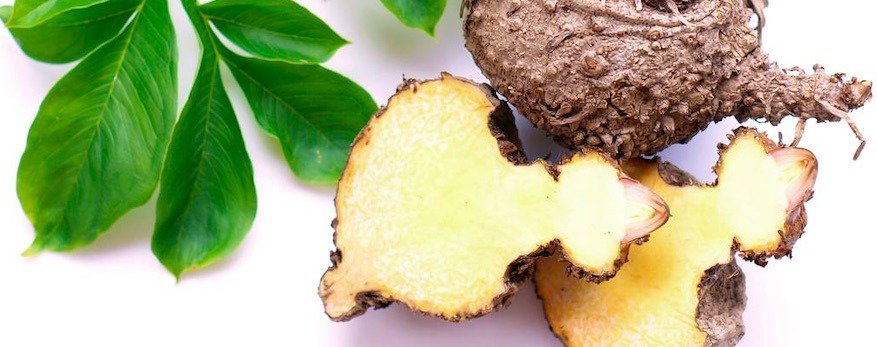
Konjac, whose scientific name is Amorphophallus konjac, is a plant in the Araceae family. Native to Asia, it grows in the tropical forests of Vietnam, China and Indonesia. It produces large leaves that can measure over one meter in height!
But it is its bulb that has been used for culinary and medicinal purposes for centuries. The earliest evidence of its use dates back more than 2,000 years.
The plant remains an integral part of traditional Chinese medicine, where it is used to relieve respiratory disorders, burns, and skin problems.
The konjac bulb is eaten like a vegetable, cooked into a gelatinous paste (“konnyaku”), vermicelli (“shiratakis”) or processed into flour.
Today, it is known and consumed worldwide for its slimming properties. Indeed, like chia seeds, psyllium or spirulina, it acts as a natural appetite suppressant and promotes satiety. But it has many other benefits. For example, it relieves digestive disorders, helps improve diabetes, reduces cholesterol levels and detoxifies the body.
Bulbs are mainly used for flour production. The 25,000 tons of flour produced each year are mostly destined for the food industry. Like guar gum, konjac is used in many foods as a thickening, gelling and emulsifying additive (under the name E425).
📚 Also read | Our guide to the best natural appetite suppressants
Nutritional composition
- Vitamins : B6
- Carbohydrates
- Fiber : glucomannan
- Starch
- Water
Benefits of konjac
🏃🏻♂️ Helps with weight loss
Konjac is made up of 30 % water and 70 % soluble fiber. Among them is glucomannan, a substance capable of absorbing up to 100 times its weight in water.
Once consumed, glucomannan transforms into a viscous gel that coats the walls of the stomach. Thus, it promotes satiety and has a satiating effect, ideal for limiting snacking during the day.
With only 3 kcal per 100 g, this plant is also among the lowest-calorie foods. Finally, by improving intestinal transit, it helps contribute to a flat stomach.
This study from the Indiana University School of Medicine (United States) shows how konjac glucomannan helps with weight loss.
♻️ Relieves digestive issues
Thanks to its high content of soluble fiber and water, konjac relieves certain digestive issues such as constipation. Indeed, its fibers improve stool consistency and ease their passage throughout the colon. Its bulb is particularly useful for slow bowel transit.
In addition, it enriches the gut microbiota. Glucomannan acts as a prebiotic, meaning it promotes the growth of certain beneficial bacteria. Like the carob or the baobab, it notably increases the population of Lactobacillus and Bifidobacteria.
This study from Chung Shan Medical University (Taiwan), conducted in constipated patients, shows how konjac glucomannan promotes bowel transit and improves the gut microbiota.
🍭 May improve diabetes
The fibers in konjac also have a beneficial effect on type 2 diabetes. Indeed, they slow the digestion of carbohydrates and prevent blood sugar spikes after meals. Glucomannan lowers blood sugar levels and helps with glycemic control.
Finally, this food has the advantage of containing no sugar. Its glycemic index is not just low… It’s simply 0 !
This study from the West China University of Medical Sciences, conducted in diabetic patients, shows how konjac reduces blood glucose levels.
🍳 Reduces cholesterol levels
In various studies, konjac has shown beneficial effects for reducing blood cholesterol. In particular, it lowers LDL cholesterol (or “bad cholesterol”) that accumulates in the arteries and is a cardiovascular risk factor.
This action is largely due to the glucomannan it contains. In addition to absorbing excess cholesterol, this soluble fiber traps bile salts produced by the liver from cholesterol. The organ is therefore forced to produce more and draw on cholesterol reserves, thereby preventing it from accumulating in the body.
This study from the University of Toronto (Canada), conducted in humans, shows how konjac glucomannan reduces cholesterol levels.
💎 Detoxifies the body
Konjac is interesting for eliminating toxins as part of a detox regimen. Its fibers, which turn into a viscous gel, have the ability to capture toxins and to “clean” the intestinal walls. It thus promotes the elimination of waste through bowel movements and frees the body from accumulated toxins.
But further studies are still needed to confirm konjac’s detoxifying action on the body.
👩🏻⚕️ Konjac and authorized health claims
EFSA, the European Authority of food safety, authorizes certain health claims related to the consumption of konjac and glucomannan.
Thus, since 2009, it recognizes the benefits of glucomannan in maintaining a normal cholesterol level. EFSA also acknowledges that it contributes to weight loss as part of a low-calorie diet.
How to consume konjac?
Konjac tablets
Konjac is mainly marketed in the form of tablets and capsules. They contain konjac bulb powder and are rich in glucomannan. This format is particularly useful as part of a weight-loss regimen. It is generally consumed as an appetite suppressant and taken before a meal.
To obtain satisfactory results, choose tablets or capsules sufficiently concentrated in glucomannan (about 90%). They should preferably be additive-free and plant-based.
Konjac-based preparations
Konjac is a food that can easily fit into your diet and is available in various forms. You can consume it as:
- konnyaku or konjac jelly, a gelatinous paste made from konjac flour and limewater. It is prepared in a skillet or wok ;
- shirataki, Japanese vermicelli that can replace traditional pasta ;
- konjac rice or gohan, in grain form ;
- konjac flour, a useful culinary aid to thicken and add creaminess to preparations.
Konjac has a fairly neutral taste. So don’t hesitate to add spices and aromatic herbs. It is ideal as a side dish for meats, fish, or vegetables.

Consume sustainably: choose organic and fair-trade konjac
✓ Most of the konjac offered on the market comes from Asia. China and Japan are the world’s main producers. If China exports more than half of its production, Japan directs it to domestic use.
✓ If you can, choose konjac grown organically and in regions far from sources of pollution. Also favor fair supply chains to support the work of small producers. Feel free to contact the manufacturer to learn more about the origin of the products used.
Dosage
It is recommended to consume between 120 and 150 g of cooked konjac per day (noodles, rice…).
In capsules, the recommended dosage is 1 to 3 capsules per day for capsules dosed at 750 mg. They should be taken with a large glass of water, at least 30 minutes before a meal.
Contraindications and side effects
Consumption of konjac has certain contraindications :
- As a precaution, it is not recommended for pregnant and breastfeeding women and for young children;
- People suffering from intestinal obstruction should avoid consuming it.
- Its consumption can interact with certain medications and reduce their absorption. Consult your doctor if you are taking medication.
- People with diabetes should consult their doctor before consuming it.
Excessive consumption of konjac has certain side effects :
- Gastrointestinal disorders
- Bloating
- Flatulence
- Diarrhea
If you experience any side effects, stop using it and consult a doctor.
Report prepared by Julia Perez
Sources and scientific studies
Melinda Chua, Timothy C Baldwin, Trevor J Hocking, Kelvin Chan, 2010. Traditional uses and potential health benefits of Amorphophallus konjac K. Koch ex N.E.Br.
D E Walsh, V Yaghoubian, A Behforooz, 1984. Effect of glucomannan on obese patients: a clinical study.
Hsiao-Ling Chen, Han-Chung Cheng, Wen-Tsu Wu, Yann-Jiu Liu, Su-Yuan Liu, 2008. Supplementation of konjac glucomannan into a low-fiber Chinese diet promoted bowel movement and improved colonic ecology in constipated adults: a placebo-controlled, diet-controlled trial.
C Y Huang, M Y Zhang, S S Peng, J R Hong, X Wang, H J Jiang, F L Zhang, Y X Bai, J Z Liang, Y R Yu, et al, 1998. Effect of Konjac food on blood glucose level in patients with diabetes.
Hoang Vi Thanh Ho, Elena Jovanovski, Andreea Zurbau, Sonia Blanco Mejia, John L Sievenpiper, Fei Au-Yeung, Alexandra L Jenkins, Lea Duvnjak, Lawrence Leiter, Vladimir Vuksan, 2017. A systematic review and meta-analysis of randomized controlled trials of the effect of konjac glucomannan, a viscous soluble fiber, on LDL cholesterol and the new lipid targets non-HDL cholesterol and apolipoprotein B.
