


Nigella, a plant that strengthens and purifies hair
What is black seed oil?
Nigella is a plant native to Asia, related to the anemone. Its nickname, \”black cumin\”, comes from the culinary use of its black seeds. Their flavor is quite strong and pungent. In India, black cumin is often used as a spice to flavor curries or chutneys, for example.
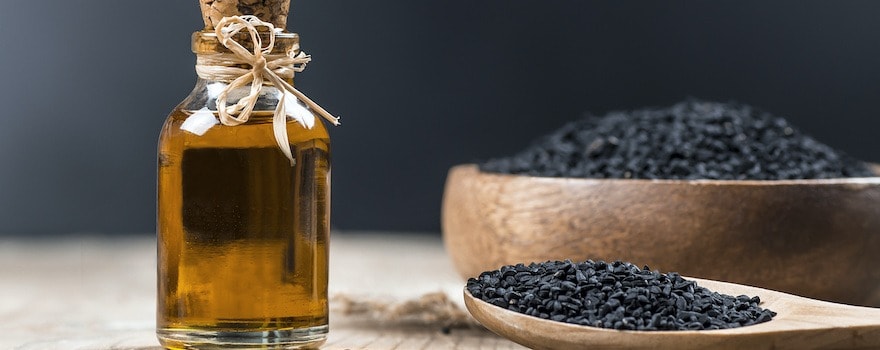
But these seeds are not only a culinary ingredient; they are also used for therapeutic purposes because of their many virtues. Black seed oil is said to soothe skin problems like acne. But it’s also a valuable ally for hair health! The oil is obtained after grinding and pressing the seeds.
The benefits of black seed oil for hair
Like spirulina or fenugreek oil, black seed oil has benefits for hair health. This oil has strong antioxidant activity, which protects the body against the action of free radicals. One of them, the thymoquinone , has an anti-inflammatory and antimicrobial role as highlighted by this study. Black seed oil would therefore be a natural remedy to soothe scalp conditions such as eczema or psoriasis.
Among the plant’s other components are omega-6 and omega-9. This content of fatty acids, coupled with its cleansing action, makes it particularly interesting for relieving scalp problems.
Black seed oil could have a beneficial effect on hair loss. This study shows that a vegetable oil containing black seed reduced participants’ hair loss by three-quarters.

Black seed oil may be useful for fighting dandruff because it could help keep the scalp well hydrated. However, clinical studies are needed to confirm this.
Also read the How to choose a dietary supplement for hair
This other study highlights the effect of a preparation based on nigella oil on the Telogen effluvium. It is a temporary hair loss most often resulting from a period of intense stress. Larger-scale studies are expected to confirm this effect.
Nigella oil can be recommended in cases of psoriasis, as shown by this study. This inflammatory skin condition can affect the scalp and present as itching and an increase in dandruff. This other study highlights its potential effect on atopic eczema.
How to use black seed oil on hair?
Choosing the right black seed oil
Nigella oil has a yellow-orange color and a fairly strong, aromatic scent. It is available in bottles or capsules. You can find it in stores specializing in herbal medicine, in most health food stores, and in some parapharmacies. You can also order it online.
- On peut choisir de l’huile de nigelle “non filtrée” qui présente une jolie couleur noire. Elle est généralement récemment pressée. Cela peut être un gage de qualité.
- L’Ethiopie est un pays reconnu pour la qualité de sa culture de graines de nigelle. Il est important d’opter pour une huile de qualité pour profiter au mieux de ses propriétés.
- On la choisira 100 % pure et bio de préférence.
- On favorise une huile issue d’une première pression à froid. Le pressage à froid, sans chauffage, permet de conserver au maximum les principes actifs des graines.
Is black seed oil dangerous?
Check with a specialist to ensure you do not have any contraindications to the use of nigella oil or any risk of drug interactions. Because it contains essential oils, it is not recommended for pregnant women or children.
It is not dangerous if these recommendations are followed, but avoid applying it to the eyes and mucous membranes, and stop use if you experience an allergic reaction or irritation.
Black seed oil for external use on hair
Thanks to its anti-inflammatory and antibacterial properties, it can help relieve certain scalp conditions such as psoriasis.
As we saw earlier, it can stimulate hair growth and strengthen hair. In addition, some claim that its richness in omegas can moisturize the hair and make it more supple.
Because of its benefits, black seed oil is used in cosmetics in care or shampoo formulations. Some preparations are certified organic, and you can even find solid shampoo bars.
For those who wish to make their own homemade treatment, here are some examples of hair care recipes using black seed oil.

Hair care ideas using black seed oil
It is recommended to use black seed oil mixed with other oils at a maximum proportion of 30% because its essential oil content remains relatively high. It can be diluted in a more neutral vegetable oil, such as avocado oil. In terms of dosage, one to two external applications per day are recommended.
Treatments to relieve irritated scalps
- On peut tout simplement appliquer un bain d’huile de nigelle sur son cuir chevelu en l’associant avec d’autres huiles végétales. On massera le cuir chevelu pour bien faire pénétrer la préparation.
- On peut l’associer à de l’huile de jojoba qui aurait un effet bénéfique sur les pellicules. Et rajouter quelques gouttes d’une huile essentielle indiquée en cas de cuir chevelu irrité comme l’huile essentielle de géranium ou de lavande.
Hair treatments for hair loss
- Afin de de favoriser la pousse et renforcer les cheveux, on peut réaliser une préparation fortifiante à base d’huile de fenugrec et d’huile végétale de moutarde.
- Ou bien l’associer à de l’huile de ricin, bien connue pour rendre les cheveux souples et moins cassants.
- On peut par exemple mélanger une cuillère à soupe d’huile de nigelle, une cuillère à soupe d’huile de ricin, une cuillère à soupe d’huile d’avocat et une cuillère à café de miel. On mélange tous les ingrédients et on applique la préparation sur la chevelure en commençant par le cuir chevelu. On laisse poser toute une nuit avec une charlotte.
