

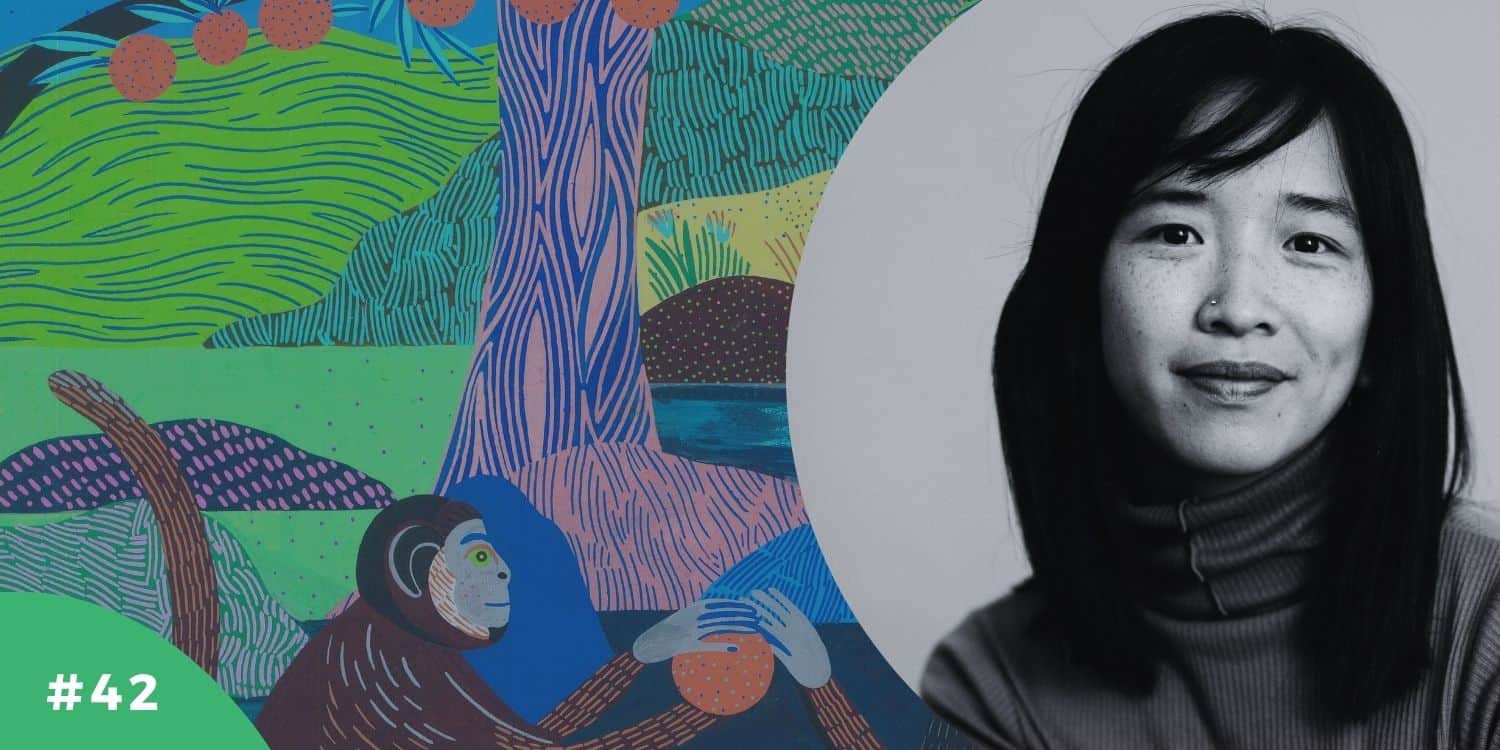
Today we’re broadening the scope. We think about the act of eating from the margins of media spectacle and societal injunctions. We zoom out and let go of guilt. I read Émilie Laystary’s book “Passer à table” and it made me want, like her, to “shake the tablecloth and make the plate an ideal magnifying glass for grasping our plural identities.” We’ll talk about decolonial food, the limits of locavorism, Afro-veganism, gender roles, supermarket neon lights, and the right to food. We won’t forget that the joy of feasting grows in conviviality.
The guest: Émilie Laystary
Émilie Laystary is a society journalist (Libération, Regain magazine, Mediapart, etc.). For 4 years, she hosted the successful podcast Bouffons produced by Nouvelles Écoutes. Her work focuses on food and the act of eating as a lens for analyzing social issues. She teaches a “Social Issues” seminar in the “Drinking, Eating, Living” master’s program at Sciences Po Lille.
My questions
- At the beginning of the text, in the wake of Donna Haraway, who conceptualized the notion of “situated knowledge,” you present your approach and the place from which you speak. Can you tell us about it?
- Could you remind us which items on our plate are the result of colonization? How do you decolonize and de-whiten a plate?
- Very quickly in the book, you describe the violence done to minorities in kitchens. Can you tell us about it?
- You have a lot of literary references in your text, which moved me. You’re obviously talking about Proust’s madeleine. Would you tell us about your own madeleines?
- You mention the “poisoned feast,” a concept developed by anthropologist Fanny Parise. Could you explain what that is?
- Would you also tell us about Edouard Glissant and the Banh Mi, a manifestation of the inventiveness of the Vietnamese people?
- You are skeptical about locavorism, why is that?
- We’re just finishing “Dry January” as we record, and you are writing a chapter on the history of “manly drinking.” What is this gendered assignment?
- As for women, how can they ignore the aggressive marketing of a heteropatriarchal society and its contradictory injunctions?
- Narcissistic retreat versus collective struggles, how do we change the world?
- You wrote a fascinating chapter on coffee; I find that we do not talk enough about the conditions in which it is produced, its colonial history, and its efficiency logic. What do we replace it with?
- Imagine that you are Minister of Education: what do you decide for school cafeterias?
- Could you explain to us what food social security is?
- Your favorite recipe?
Resources to go further
All episodes
A podcast hosted by Louise Browaeys with technical support from Matthieu Brillard
Photo © Leonor Lumineau
