


Best digestive enzymes in capsule form
Our selection criteria
- Origin: enzymes can be of animal, plant, or microbial origin.
- Composition: digestive enzymes contained in the supplement.
- Amount of lactase: lactase is essential for the digestion of dairy products (in ALU).
- Certificate of analysis: verification of the absence of heavy metals and suspicious solvents
- Price / day: this is the price per day of the course at the brand’s recommended daily dose.
- Customer reviews: these customer reviews of the product are retrieved from the brand’s website, review sites, or Amazon.
- Our opinion on the brand: based on the tests of supplement brands we perform each month.
Our choice
✪✪✪✪✪
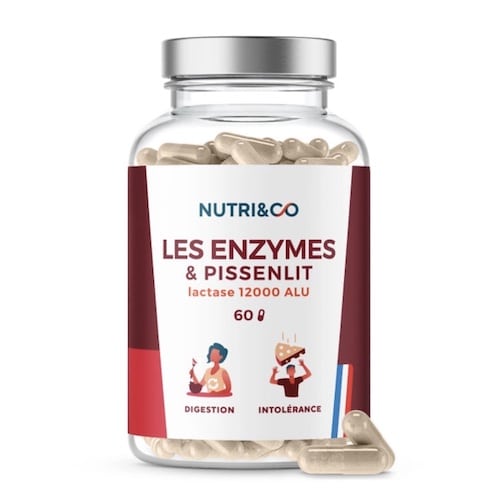
Darwin Nutrition®
Marque : Nutri&Co
Origine : non-animale
Composition : lipase, papaïne, protéase, amylase, cellulase, α-galactosidase, pissenlit
Quantité de lactase : 12 000 ALU
Certificat d’analyse : conforme
Prix / jour : 0,86€
Avis clients : 4,8/5 (ekomi.fr)
We selected the Nutri&Co digestive enzyme supplement for the quality of its nutritional composition.
It contains 7 enzymes with high activity, which helps both to fight intolerance to dairy products and to handle a large meal.
This supplement contains a very large amount of lactase (12,000 ALU for 2 capsules) to provide real effectiveness against lactose intolerance.
We like the Nutri&Co brand because it is reliable and transparent (read our full review here to learn more). We also note that customer reviews are very good.
This brand is based in Aix-en-Provence and places particular importance on the quality of the active ingredients in its products.
What are digestive enzymes for ?
Proteins essential for digestion
Digestive enzymes are naturally produced by the body. They are proteins that promote biochemical reactions in our body.
During digestion, their role is to break down food substances into smaller pieces to facilitate their absorption: this is called food hydrolysis.
There are 3 main types of digestive enzymes.
The glycolytic enzymes
Amylase, for example, is an enzyme secreted by the salivary glands and the pancreas, allowing the digestion of complex carbohydrates (it breaks down carbohydrates into glucose molecules).
Lactase is an enzyme that helps digest milk.
The lipolytic enzymes
Lipases, for their part, handle fats; they are found in the stomach and in the intestine, where they break down triglycerides.
These lipids can lead to cardiovascular disorders when they are present in excess in our bodies. In addition, without lipase, fat-soluble vitamins (A, D, E, K) become deficient.
The proteolytic enzymes
Proteases, notably pepsin, break down proteins into amino acids. This enzyme also plays a barrier role in the intestine and preserves the integrity of the digestive membranes.
A lack of proteases can lead to allergies or the entry of foreign agents into the intestine.
Enzymes are present throughout our digestive tract: amylase is found in the mouth, pepsin in the stomach, lipase, proteases, and amylase in the pancreas, and lactase in the intestine.
When should you supplement with digestive enzymes?
Digestive enzymes are therefore essential for facilitating digestion, particularly in certain conditions where the digestive system poorly absorbs the nutrients provided.
This is the case with exocrine pancreatic insufficiency, a disorder leading to problems in the production of digestive enzymes or in their action.
Cases of food intolerance can also be improved by taking digestive enzymes.
The natural aging of the body leads to enzyme deficiencies, reducing proper absorption of nutrients and causing the onset of digestive disorders.
Finally, in the case of an overly large meal, our digestive enzymes may have difficulty hydrolyzing the entire food bolus.
Food is then incompletely digested, and ferments in our digestive tract. This can cause digestive problems such as bloating or gas.
Supplementation does not replace our endogenous enzymes, but can come in to support the work of our natural enzymes.

The benefits of digestive enzymes
An effect on digestion
Digestive disorders can occur when digestion is incomplete: bloating, diarrhea, stomach pain, cramps.
In a study, 62 people with digestive disorders took, for 5 days, either a capsule of an enzyme complex or a capsule of domperidone, a medication commonly used to relieve nausea and vomiting.
The enzyme complex was found to be more effective than the medication at reducing abdominal pain.
For the other symptoms (bloating, heartburn, nausea) the two products had the same effectiveness.
An effect on gluten intolerance
Between 1 and 6 % of the population would suffer from NCGS: non-celiac gluten sensitivity.
Symptoms include fatigue, headaches, bloating, and alternating diarrhea and constipation.
They are observed in people consuming foods containing gluten, and who feel better when they follow a gluten-free diet, but who do not have celiac disease.
This sensitivity reduces patients’ quality of life. A clinical trial with an enzyme blend found a significant reduction in symptoms in these individuals after administration of the blend, compared with placebo.
The improvement was particularly pronounced for the sensation of incomplete evacuation and headaches.
An effect on lactose intolerance
80% of the world’s population (over age 7) is lactose intolerant, according to France Assos Santé.
Lactase deficiency, lactase being the major enzyme that enables proper digestion of lactose, is the primary cause of lactose malabsorption and the accompanying gastrointestinal disorders.
New observations indicate that digestive enzymes can improve lactose intolerance, reduce digestive disorders and malabsorption.
An effect on digestive disorders
As this study notes, digestive enzymes are used as treatment in conditions affecting the pancreas, which can lead to malnutrition (pancreatic insufficiency, pancreatitis, cancer).
They are also one of the therapies indicated for patients with cystic fibrosis or diabetes.
Supplementation can significantly improve the quality of life of these patients.
Finally, digestive enzymes are also considered promising in the management of celiac disease (gluten intolerance) as an adjunct to other treatments.
An effect on bad breath
As shown by this analysis, the activity of certain digestive enzymes, particularly beta-galactosidase, is linked to bad breath.
Beta-galactosidase, which is part of the lactases, is one of the most important enzymes for breaking down lactose.
By measuring the level of beta-galactosidase in saliva, one indirectly assesses the synthesis of malodorous substances in the mouth.
Furthermore, poor digestion can cause bad breath. Thus, sufficient digestive enzyme activity helps maintain fresh breath.
The different forms of digestive enzymes
In capsules
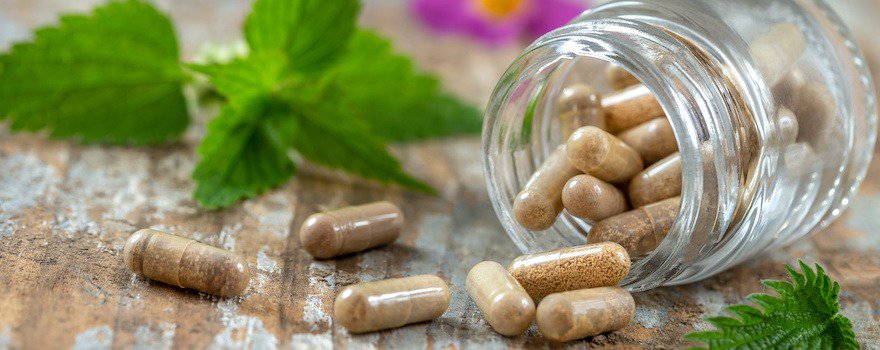
Digestive enzymes are generally available in capsule form, because this form makes it easy to mix multiple types of enzymes.
Manufacturing is easy and the cost is moderate. Capsules mask taste and odors.
However, they are sensitive to moisture, and can be a problem for people with swallowing difficulties.
One to three doses per day may be necessary to meet needs.
In tablet form
This form, obtained by compressing powders, is also available. The advantage of the tablet is its easy storage. Tablets also allow precise dosing.
However, tablet manufacturing may involve chemical substances, to the detriment of the quality of the final product.
In powder form
The powder is diluted in water or sprinkled onto food. It may contain a single type of enzyme (papain, bromelain) or a complex of enzymes.
This bulk form generally has a low dosage or requires multiple doses. Sensitive to oxidation and moisture, they can therefore be more easily contaminated by germs.
The criteria to take into account
1. Origin of digestive enzymes
Animal
Animal-derived digestive enzymes come from the stomach or the pancreas of cows or pigs.
They are not effective throughout the entire digestive process, because they mainly work in the presence of a high pH, that is, in the stomach.
This type of enzyme can break down proteins, thus aiding their digestion, but is less effective on sugars and fats.
Included is pancreatin, a powder containing a mixture of pancreatic enzymes (pepsin, lipase, trypsin…). This pancreatin is used as a medication in the treatment of pancreatic insufficiency.
Plant-based
Some foods naturally contain digestive enzymes: papaya or pineapple contain proteases (papain and bromelain), bananas and mangoes contain amylase, avocados or apples contain lipases, etc.
They are effective across different pH levels, and thus aid digestion from the stomach to the intestine. The protein hydrolysis efficiency is comparable to animal-derived enzymes, but equally low for sugars and fats.
Microbial
These enzymes are made from fermented fungal substances (fungi). The enzymes produced are then extracted and form a blend of multiple enzymes free of microbial residues.
Microbial-origin digestive enzymes can come from cultures of fermented foods (barley, soy). The fermentation of these compounds allows the development of microorganisms such as the fungus Aspergillus.
2. Enzymatic activity
A large amount of enzymes does not mean that their enzymatic activity is adequate. Enzymatic activity is a proportion of the number of active enzymes in a solution.
It is measured in enzyme activity unit (UI), or by another unit specific to the enzyme.
For example, bromelain has an activity that is expressed in “GDU” (gelatin digestion units), and measures bromelain’s ability to break down gelatin, which is rich in protein.
3. Product composition
You will find dietary supplements containing a specific enzyme, such as bromelain.
This enzyme is intended to reduce digestive disorders (but has no scientific claims) because it has the ability to digest proteins.
There are also enzyme blend formulas, for a synergistic effect.
Check that the product contains a broad spectrum of digestive enzymes, with at least proteases, lipases, amylase, and lactase.
A blend acts on the entire digestive tract, depending on the pH of the various organs.
4. Presence of excipients
Dietary supplements containing digestive enzymes may contain many excipients, resulting from the product’s manufacturing.
If you suffer from allergies, check that the product does not contain allergens (gluten, soy, milk, peanuts).
The manufacture of tablets or powder can cause the presence of preservatives to be taken into account (corn- or wheat-derived maltodextrin) or additives such as silicon dioxide, a potential source of nanoparticles.
5. Precautions for use
Enzymes derived from fruits should be used with caution in people suffering from food hypersensitivity (bromelain, papain, kiwi).
As a precautionary principle, these products are not recommended for pregnant or breastfeeding women, nor during medication treatment unless advised by a physician.
Watch out for side effects! Digestive issues may occur, such as constipation or abdominal cramps.
The best sources of digestive enzymes in the diet
Digestive enzymes are naturally found in the raw, unprocessed foods, but heat destroys them easily.
It is recommended to start meals with fresh, raw foods to promote enzyme intake. Prefer gentle cooking methods, and chew your food slowly.
Some foods contain specific digestive enzymes, including:
- papaya (papain),
- pineapple (bromelain, found in many dietary supplements),
- banana (amylases),
- avocado (lipases).
The fermented foods also contain them: olives, pickles, capers.
To summarize
To make sure you choose high-quality digestive enzymes, check:
- Origin: animal, plant, or microbial
- Enzymatic activity : it does not depend on the quantity of enzymes but on the proportion of active enzymes in a solution, measured in enzyme activity units (UI), or similar
- Product composition: check that the product contains a broad spectrum of digestive enzymes, with at least proteases, lipases, amylase, and lactase.
- Presence of excipients: watch for allergens, preservatives, and additives
- Precautions for use: for people suffering from food hypersensitivity, pregnant and breastfeeding women, and people taking medication. Seek medical advice.
