

Listen to this episode
What is the link between the brain and the gut? Between psychology and the microbiome? How does what we eat influence our emotions? How can our diet be a pleasure but also a real factor in psychological balance?
That’s what we’ll explore with our guest today.
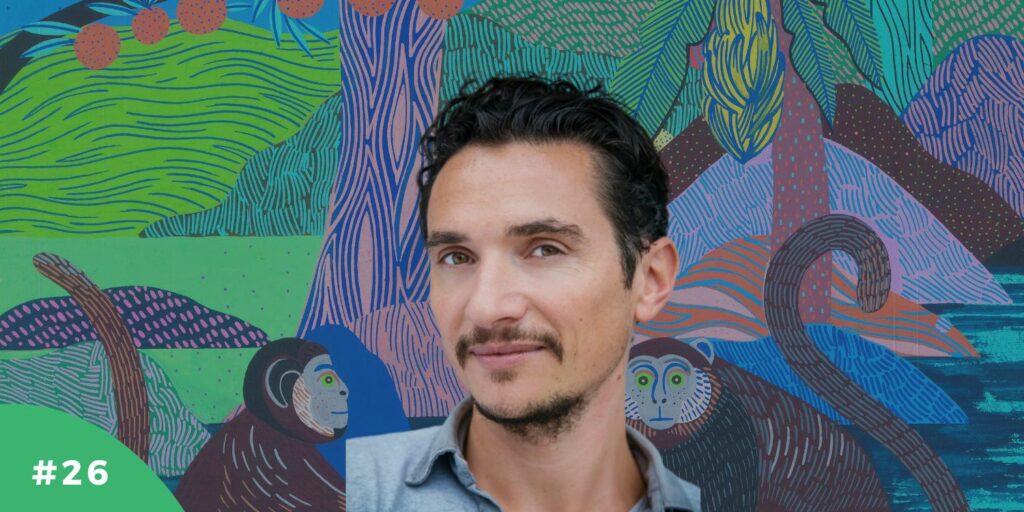
Guest: Guillaume Fond
I discovered Guillaume Fond in a documentary and appreciated his combination of gentleness, lucidity, and scientific rigor. He is a psychiatrist and researcher at the hospitals in Marseille. He teaches at the medical school and is a speaker and trainer.
He is the author of more than a hundred articles published in psychiatric journals, and his work has received numerous awards.
In 2022 he published “Eat Well to Stop Being Depressed” with Éditions Odile Jacob.
My questions
- As a psychiatrist, how did you become interested in nutrition?
- Could you remind us of the definition of the microbiome, and tell us about the latest discoveries concerning the links between the microbiome and the brain?
- As a psychiatrist, do you observe an increase in depression? What are the exact symptoms of depression? Are there other psychiatric disorders linked to diet? (bipolar disorders, autism…)
- What are your nutritional recommendations to stop being depressed?
- More broadly, what good habits should one adopt?
- Are there little-known or even counterintuitive nutritional recommendations?
- Are there any dietary supplements of interest on this topic? (I noticed the emphasis you give to omega-3s in your book…)
- Conversely, which foods or diets should be avoided?
- Is there a difference between men and women due to hormones?
- Do you have specific advice for children? And for seniors?
- Do you have any examples of patients whose recovery was particularly impressive?
Resources for further exploration
- Eat well to stop feeling depressed, Guillaume Fond
- Guillaume’s YouTube channel
- I make my life into a big project, Guillaume Fond
- An interview with Guillaume on psychonutrition, on Cerveau & Psycho
