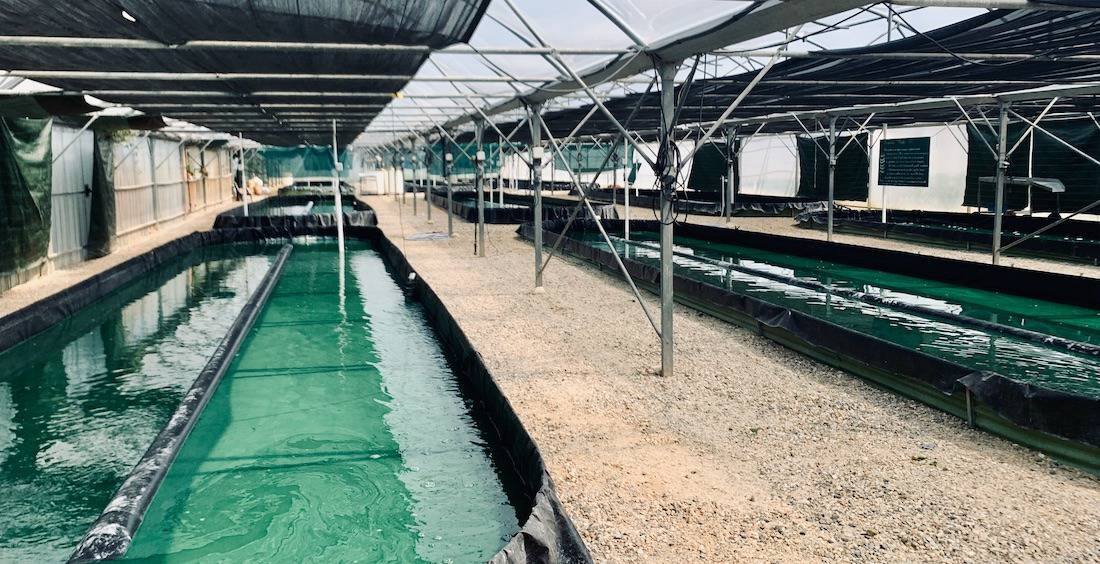
While spirulina and its exceptional benefits are beginning to be known to the general public in France, its origin, its producers and France’s leadership position are less well known. Thus, over the past 5 years, the number of French spirulina producers has doubled and their revenue has quadrupled — the result of know-how and an organization unique in the world.
Discover our study carried out in partnership with the Federation of Spirulina Growers of France on French spirulina production, and feel free to share our infographic!
Spirulina, ‘the food of the future’ according to the UN

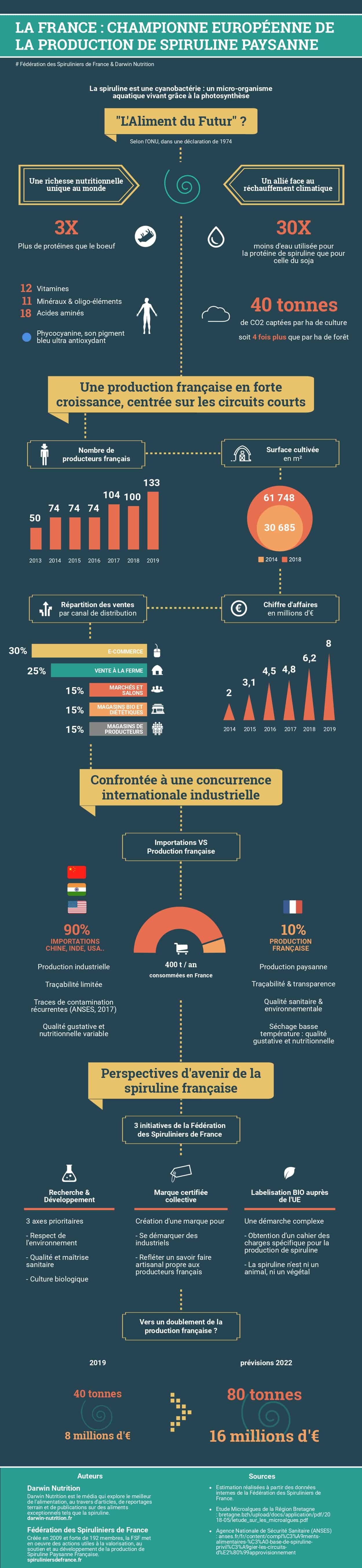
Spirulina is a cyanobacterium: a microscopic aquatic organism that lives by photosynthesis. It has existed for 3.5 billion years. Halfway between the animal and plant worlds, spirulina is considered the most nutrient-dense food and the most balanced after breast milk. It contains three times as much protein as beef, 12 vitamins, 11 minerals and trace elements, and 18 amino acids.
Beyond its exceptional nutritional characteristics, spirulina has unique environmental qualities. Spirulina protein production uses 30 times less water than soy protein production, and the growth of the cyanobacterium involves the absorption of large quantities of CO2 and the production of oxygen.
French production is experiencing strong growth, centered on short supply chains.

Global spirulina consumption is exploding, as it is consumed by both humans and animals and used in certain industries, notably in cosmetics. The global spirulina market was estimated at $1M in 2018, growing 11% per year (source: Allied Market Research).
The structure of the French market is particularly distinctive: production is fragmented among an increasing number of small producers (rising from 50 in 2013 to 133 in 2019) who cover the French territory and serve a primarily local market. French spirulina is mainly sold through short supply chains – e-commerce, farm sales, markets and trade shows account for 70% of sales – which preserves producers’ margins.

This choice appears successful since between 2014 and 2018 cultivated areas doubled, and producers’ revenue tripled to reach more than €6M in 2018.
Industrial international competition that accounts for the bulk of sales in France.

With an estimated total consumption of 400 tonnes, France is one of the major spirulina markets worldwide.
Imported spirulina accounts for 90% of French consumption. Ultra-competitive in terms of cost, it is produced mainly in China, India and the United States on large industrial farms. The production method, and in particular the spirulina drying techniques (high/low temperature), is responsible for a major quality difference between imported products and French production often described as ‘small-scale’.
Beyond contamination issues, noted notably by the ANSES as early as 2017, industrial spirulina generally provides no traceability information, and has poorer taste and lower nutritional value than artisanal spirulina produced in France.
The future prospects of French spirulina.

Representing around 80% of French spirulina producers, the Federation of Spirulina Producers of France is working on 3 major initiatives:
- Since its creation in 2009, R&D has been a top priority: the aim is to optimize the spirulina production and control processes, with the goal of achieving ever higher nutritional, sanitary, and taste quality, for a fully controlled ecological footprint.
- The FSF is also working on creating a certified collective brand, which would allow French producers to differentiate themselves from imported products, and which would reflect their unique expertise.
- Organic certification of French production by the European Union is a crucial initiative, though complex from a regulatory standpoint. The stakes are high: many imported products are labeled “organic” under equivalence rules between the EU and the exporting country, and this occurs without visibility or control over production conditions.
Given these initiatives and the strong growth in consumption in France, it is estimated that French production should double by 2022 to reach 80 tonnes, and €16 million in annual revenue.