
Sponsored article
Creatine is not an invention of sports nutrition: it is above all a molecule that our body naturally produces, and that is found in small quantities in certain foods such as meat or fish.
It plays a very specific role in the body: it is involved in the regeneration of ATP, the main source of energy for the muscles during short, very intense physical efforts. Thanks to this rapid production of ATP, we can perform sprints, jumps, or sets in weight training.
In other words, creatine allows muscles to contract more quickly and more powerfully. It is precisely for this effect that it has become the most studied dietary supplement in sports nutrition. Scientific research has clearly confirmed its effectiveness.
Moreover, according to EFSA (European Food Safety Authority), a daily intake of around 3 g of creatine monohydrate can help increase performance during short, high‑intensity efforts.
And contrary to some still very widespread misconceptions, creatine is not a doping product.
For which athletes is creatine really relevant?
Creatine is especially effective during brief, intense, and repeated efforts. This means it is not necessary for all sports.
It therefore finds its place mainly in disciplines where power and explosiveness are crucial. This is the case for strength and power sports such as weightlifting, cross‑training, bodybuilding, and also boxing.
It is also recommended in explosive sports that require sprinting phases, such as soccer or basketball.
Conversely, runners or cyclists get far fewer benefits from it.
My analysis of BIOGENA creatine
As a PharmD specialized in sports nutrition, I always base myself on 5 main criteria to evaluate supplements: the product’s composition and the effectiveness of its active ingredients, the dosage, the quality of the raw materials, the athlete’s safety, and the packaging.
A deliberately minimalist formula
First point, and not the least: the composition.
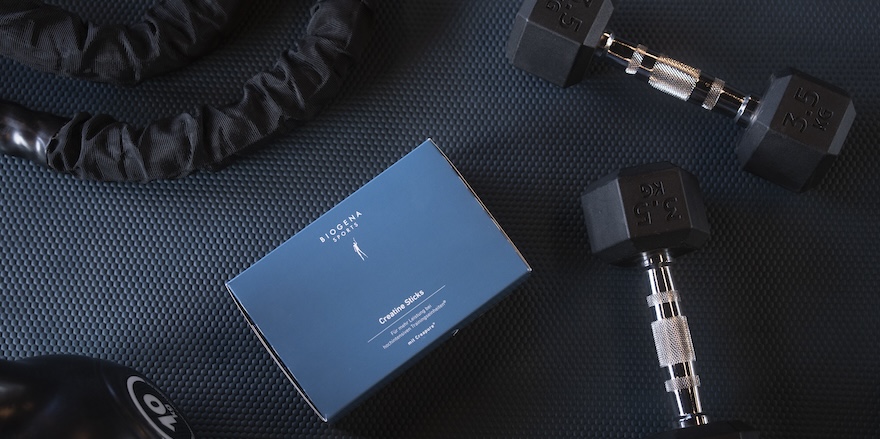
BIOGENA SPORTS creatine contains a single ingredient: creatine monohydrate.
There are no additives, flavors, fillers, or additional colorants.
Moreover, this is creatine monohydrate, the most widely studied form in scientific research. It is also the one for which we have the most data in terms of effectiveness, absorption, and digestive tolerance.
A scientifically validated dosage
Each sachet provides 3 g of creatine. This is the daily dose that is scientifically validated and recognized by European authorities for improving performance during short, high-intensity efforts.
Unlike certain practices that are still widespread, BIOGENA does not encourage loading phases or overdosing.
Its single-dose format also eliminates any risk of dosing errors.
Quality, safety, and traceability
BIOGENA SPORTS creatine uses Creapure® creatine, a raw material manufactured in Germany and considered a benchmark in sports nutrition.
For BIOGENA, ingredient quality and the reliability of their origin play an essential role and are what set them apart from many other dietary supplement manufacturers.
It guarantees high purity, strict manufacturing processes, and excellent traceability.
The product is also listed on the Cologne List®, which guarantees the absence of doping substances. It is therefore ideal for professional athletes.
Each batch is also tested by an independent institute (LEFO), with analyses focusing on impurities, heavy metals, and potential contaminants.
The sachet format: practical and precise
Accurately measuring 3 g of creatine is not always easy with a loose powder, especially without a scale or when the measuring spoon is not precise.
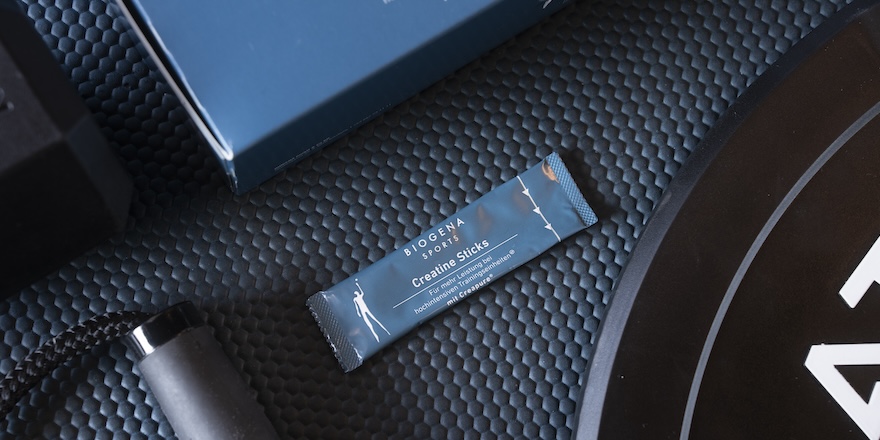
BIOGENA has therefore opted for a sachet format that contains the daily dose of creatine. This limits approximations and makes it possible to have a precise dose that is easy to take with you when traveling.