

Summary of my selection
# Best probiotic complex 🥇
> FS-3B (Full Spectrum Tribiotic) – Cuure
# Best weight-loss probiotic
> L-Gasseri – Apyforme
# Best probiotic for intimate flora
> Probio+ intima – Apyforme
Probiotics act on the microbiota in several ways. They can strengthen, support, or maintain its balance.
The microbiota is made up of a huge number of living microorganisms that are natural, physiological inhabitants of our body. More than 90% of the microbiota is concentrated in the gut, and it’s the best known. But there are other microbiotas: skin, vaginal, oral, and even pulmonary1.
The microbiota needs a proper balance, which is called symbiosis. Conversely, we speak of dysbiosis when an imbalance has occurred. There are three scenarios: an insufficient number of good bacteria, proliferation of bad bacteria, and/or a decrease in the diversity of species that make up the microbiota.
The beneficial bacteria that make up the gut microbiota play a major role in our health2. Recent research has shown the impact of the microbiota on many bodily functions3 and the possibility of combining certain microbial strains to achieve health benefits4.
Thus, you can choose to take a course of probiotics to ease certain digestive symptoms, strengthen your immunity5, improve your mood or reduce anxiety6, or to support weight loss7.
For women, specific probiotics can help reduce intimate discomforts8 or the occurrence of vaginal infections9.
Furthermore, many factors have been identified as disrupting the composition of the microbiota and contributing to its depletion: stress, pollution, a modern diet low in fiber, and the use of antibiotics.
Hence the benefit of strengthening your microbiota to counter these harmful factors, in addition to maintaining good lifestyle habits.
Brands evaluated: Apyforme, Belloc, Cuure, Dijo, FortePharma, Granions, Juvamine, Novoma, Nutri&Co, Nutrimea, Nutripure, TerraVita, Vitavea.
We evaluate all dietary supplements independently. If you click on one of the provided links, a commission may be paid to us, without affecting the price or the ranking.
Methodology
This comparison features probiotics frequently purchased online, with a large number of reviews.
Some products are specifically designed to act on the gut microbiota, while others are formulated for the vaginal microbiota or for weight loss.
From the available resources, I analyzed the composition of each of these probiotics according to three criteria: nutrition, safety, and brand. I also compared prices for a reference of 10 billion CFU.
In total, 15 probiotics were analyzed. I selected the best probiotic overall across all supplements, then the best specialized probiotics (weight loss, vaginal flora). Finally, I highlighted the best probiotic combined with prebiotics.
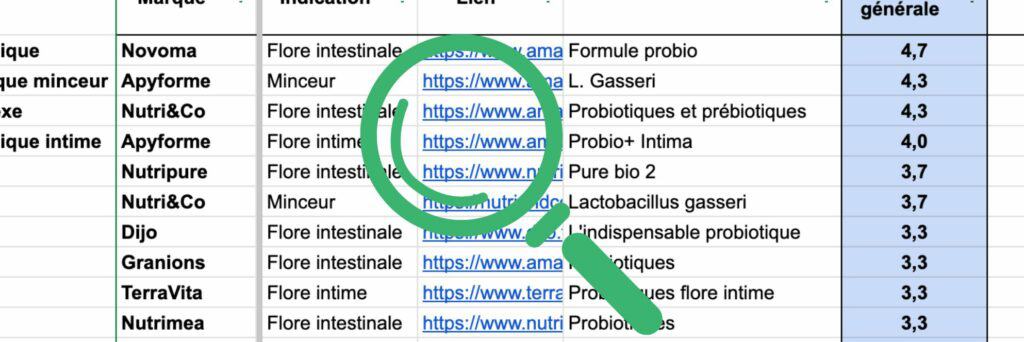
→ Access my full comparison table here (Google Sheet)
1. Nutritional value
I noted the number and variety of strains used. The strains that make up the supplement must be both diverse and numerous enough to reach the intestinal tract.
Overall, these strains belong to two major families of bacterial species: Lactobacilli and Bifidobacteria.
The best-known strains include: Lactobacillus rhamnosus, Bifidobacterium longum, Lactobacillus helveticus, Lactobacillus gasseri, Lactobacillus plantarum.
I took into account the number of CFU (colony-forming units) per capsule. These units represent the number of live bacteria per dose.
I paid close attention to this CFU number because there is great heterogeneity in how this information is reported. Some brands state the amount per recommended dose, others per capsule, or per gram of product, which greatly changes the data depending on the criterion used. I therefore chose to report the number of CFUs contained in a capsule to harmonize the comparison.
Additionally, the recommended dosages vary widely from one brand to another. Some suggest a single dosage while others recommend a different amount depending on whether it’s a loading or maintenance treatment. The number of capsules to take daily then varies considerably.
Another major point regarding the quality of a probiotic concerns the resistance of the capsule’s coating to stomach acid.
The capsule is essential. Indeed, its shell must be gastro-resistant, meaning it should not open upon contact with stomach acid, to avoid releasing its contents there. The goal is to deliver the probiotics intact to the intestines, where they should, as much as possible, be released alive and intact.
Some brands specify the name of the capsule coating manufacturer, others do not and do not readily indicate whether it is gastro-resistant.
Finally, I noted the presence of prebiotics and other active substances. In general, probiotics are fragile entities sensitive to their environment. It is not necessarily advisable to combine them with other substances.
2. Safety
I examined the origin of the probiotics and whether they were patented.
Some strains are described as generic and others are patented. The so-called patented strains have demonstrated specific clinical benefits.
Although available without a prescription, probiotics are products whose manufacturing must be meticulous and tightly controlled. We are dealing with fragile, sensitive living microorganisms that will have to make their way through an environment hostile to them all the way to the colon. The selected strains must prove to be stable and resilient.
The manufacturing process is therefore very important and requires ensuring the protection of the strains at different stages (production, transport, storage)10. I therefore gathered information on the manufacturing conditions and all the data provided by the brands on their websites. This provides an indication of the quality of the product selection.
I noted the presence of additives. Ingredients should be free of additives and contain as few artificial agents as possible.
Probiotics are sensitive to moisture and heat. Sensitivity to water requires major precautions during the manufacturing process and the use of the least harmful anti-caking agents possible.
3. Brand
I took the brand’s reputation into account based on its age (founding date) and its popularity (number of Instagram followers).
I noted the number of product reviews and its rating on Amazon (when it was sold on that platform) as well as on review verification organizations (Trustpilot, Avis Vérifiés). I did not take into account reviews on the brand’s own website, which cannot be guaranteed to be fully objective.
I also noted the transparency and the level of information provided by the brands.
Indeed, the field of probiotics is rapidly expanding. The marketing stakes are enormous. It is reassuring to know the brands’ approach, especially in their choice of strains.
It seems to me that the most transparent brands benefit from being highlighted. They are the ones that provide complete information and make knowledge accessible to the general public.
Finally, consumers naturally look at the product’s purchase price, but not all contain the same number of capsules nor the same number of CFUs per capsule. So I calculated the cost for a quantity of 10 billion CFUs. This reference, although imperfect, has the advantage of establishing a price normalized to the same quantity.
The average of the selection is €0.40 for 10 billion CFUs.
Best probiotics: my review
# BEST PROBIOTIC COMPLEX 🥇
Cuure
Rating: 5/5
Nutrition: ★★★★★
Safety: ★★★★★
Brand: ★★★★★
Advantages
- Ultra-comprehensive formula: pre-, pro-, and postbiotics
- A large number of strains
- Excellent protection of strains
- High concentration (50 billion CFU)
Disadvantages
- More expensive than average
- New product on the market
Launched in 2019, Cuure has established itself as a reference in the field of personalized health. Its strong digital presence (more than 95,000 followers on Instagram) reflects an engaged community drawn to a modern, science-based vision of wellness.
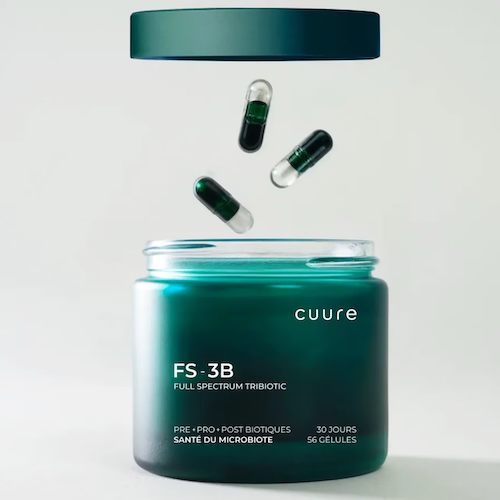
Cuure presents its most advanced formula here: FS-3B, a next-generation tribiotic with an intelligent combination. In my view, it’s a much more coherent approach to supporting microbiota health.
Unlike traditional probiotics, this formula combines 25 clinically documented strains, 6 bioactive postbiotics, and a blend of natural prebiotics derived from fermented plants.
Overall, it targets digestion, immunity, mood, skin, and even sleep.
Each capsule contains 50 billion CFU protected by a patented triple-encapsulation system, which ensures targeted release in the intestine. That’s a real plus so the strains don’t get lost along the way: they arrive where they need to act.
The product is clearly positioned as premium, priced at €59.90 for a one-time purchase. The price drops to €49.90 with the brand’s monthly subscription. This cost is justified by the richness of the formulation and the encapsulation technology.
The dosage is precisely defined: a gradual ramp-up (1 capsule for the first 4 days, then 2 capsules per day) that respects the microbiota’s adaptation period. It’s a detail that matters and shows this isn’t a product formulated hastily.
Everything is made in France, 100% vegan, non-GMO and additive-free, and packaged in eco-friendly packaging. For me, it’s flawless.
# BEST SINGLE PROBIOTIC
Novoma
Rating: 4.7/5
Nutrition: ★★★★☆
Safety: ★★★★★
Brand: ★★★★★
Advantages
- Good variety of strains
- Excellent concentration per capsule
- Good value for money
- Recycled and recyclable bottle
- Certified capsule
Disadvantages
- Imbalance in the choice of bacterial species (predominantly Lactobacilli)
Novoma is a French brand that has been offering dietary supplements for over 10 years. Well rated by customers, it offers more than twenty products at affordable prices. A community of 13,000 followers follows Novoma on Instagram.
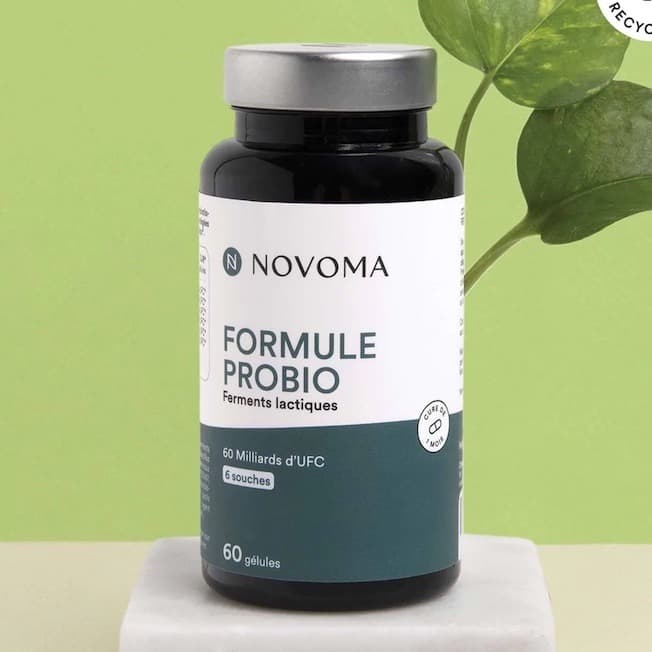
The Novoma Probio formula comes in a bottle of 60 vegetarian gastro-resistant capsules labeled DR Caps®, which protect the probiotics during their passage through the stomach.
The main indication is rebalancing the gut flora to reduce digestive discomfort and boost immunity.
Each capsule contains a blend of 6 strains (5 of which are species from the Lactobacilli family) for a total of 30 billion CFU. All these strains are patented by Syn Balance® (an Italian laboratory) and the product is manufactured in France. It is a selection of 3 blends (SmilinGut, Happy Belly and the Lacticasei Bacillus Paracasei strain) chosen for their synergistic action.
There are no other active ingredients; only rice starch accompanies the strains in the capsule.
It is recommended to take one capsule per day with a glass of water during a meal.
The bottle costs €26.90, which corresponds to a cost of €0.15 per 10 billion CFU, one of the least expensive in the selection. Note that the bottle is made from recycled and recyclable material, which is a nice eco-friendly bonus!
On the brand’s website, there is rich, detailed information about the choice of strains and the microbiota.
# BEST WEIGHT-LOSS PROBIOTIC
Apyforme
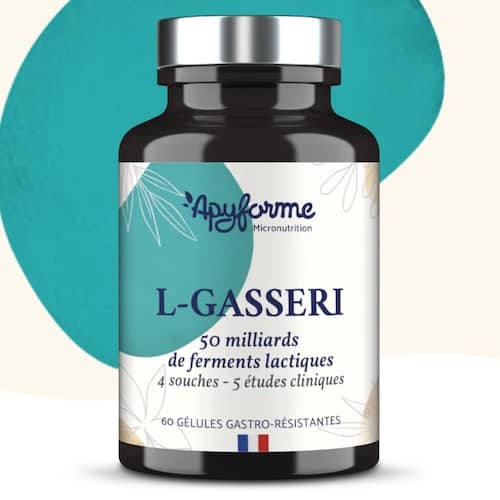
Rating: 4.3/5
Nutrition: ★★★★★
Safety: ★★★★☆
Brand: ★★★★☆
Advantages
- Interesting variety of strains for a weight-loss formula
- Good amount of CFU
- Nice and professional infographic
- Good value for money
Disadvantages
- Not quite accurate to speak of a 50 billion CFU formula that corresponds to 4 capsules (loading phase)
Apyforme is a French brand located in the Auvergne-Rhône-Alpes region. It currently offers around thirty nutraceutical products inspired by nature’s bounty. More than 20,000 people follow the brand on Instagram. Price ranges are fairly affordable and the products are well documented.
The Apyforme L. gasseri formulation contains four strains, including, of course, the well-known L. gasseri, which is now well studied in scientific research7. The other strains are L. plantarum, L. rhamnosus and B. longum, with complementary properties, one of which is patented.
The indication can help slim the figure and regulate weight by acting on intestinal balance. This probiotic should be considered a useful option as part of a weight-loss approach. However, the promised result cannot be achieved without additional measures being taken (diet, physical activity…).
One capsule contains 12.5 billion CFU, double that of competitors in the same range of the selection.
Only corn starch is added to the formula as an anti-caking agent.
The brand provides a very well-made infographic citing the relevant scientific studies.
The recommended regimen is 2 capsules in the morning on an empty stomach, preferably 30 minutes before breakfast with a cold drink. The course is advised for 2 months. The price, calculated per 10 billion CFU, is €0.32, below the average of the selection.
# BEST PROBIOTIC FOR INTIMATE FLORA
Apyforme

Rating: 4.0/5
Nutrition: ★★★★☆
Safety: ★★★★☆
Brand: ★★★★☆
Advantages
- Variety of strains suitable for intimate flora
- Adequate concentration
- Good infographic
- Good value for money
Disadvantages
- Lack of transparency on the bottle (40 billion CFU, that’s only if you do a loading regimen)
Apyforme was founded in 2008 in the Auvergne-Rhône-Alpes region. Its founder, Yoann Bonnassieux, is committed to offering pure, high-performance dietary supplements. The brand’s Instagram following has grown nicely in recent months. The product range includes around thirty products.
Apyforme offers a supplement designed to restore (or maintain) the balance of the female vaginal flora by stimulating local immunity to help fight discomforts.
The formula includes 4 probiotic strains: L. crispatus (which makes up half of the intimate flora), L. reuteri, L. acidophilus, L. rhamnosus, two of which are patented (cultivated in France and deposited at the CNCM of the Pasteur Institute). There are 10 billion CFUs per capsule, which is a correct concentration.
Corn starch is used as the anti-caking agent and the capsules are gastro-resistant.
Several dosages are indicated: 4 capsules per day for 7 days as an intensive treatment in case of discomfort, then 2 per day for 2 months. For preventive effect, it is recommended to take 2 capsules per day for 2 months.
A bottle of 60 capsules costs €19.90 and the cost for 10 billion CFUs is €0.33, about average for the selection.
However, I find it a bit misleading to prominently display 40 billion CFUs on the bottle when that only applies to taking 4 capsules. The brand indicates several dosages.
Here too, a very well-made infographic summarizes the role of the intimate microbiota, citing bibliographic sources.
Complete comparison
| Marque | NOTE | Nutrition | Sécurité | Marque |
|---|---|---|---|---|
| Cuure 🥇 | 5 | 5 | 5 | 5 |
| Novoma | 4.7 | 4 | 5 | 5 |
| Apyforme Weight Loss | 4.3 | 5 | 4 | 4 |
| Nutri&Co | 4.3 | 4 | 4 | 5 |
| Apyforme Intimate | 4.0 | 4 | 4 | 4 |
| Nutri&Co Weight Loss | 3.7 | 3 | 3 | 5 |
| Nutripure | 3.7 | 3 | 4 | 4 |
| Dijo | 3.3 | 3 | 3 | 4 |
| Granions | 3.3 | 4 | 3 | 3 |
| Nutrimea | 3.3 | 3 | 4 | 3 |
| TerraVita Intimate | 3.3 | 4 | 3 | 3 |
| FortePharma Intimate | 3.0 | 4 | 2 | 3 |
| TerraVita Weight Loss | 3.0 | 3 | 3 | 3 |
| Vitavea | 3.0 | 3 | 3 | 3 |
| Belloc | 2.7 | 3 | 3 | 2 |
| Juvamine | 2.3 | 2 | 3 | 2 |
→ Access my complete comparison table here (Google Sheet)
Frequently Asked Questions (FAQ)
How long does it take for probiotics to work?
It’s difficult to give a general answer to this question because the indications and individual situations vary considerably. Sometimes you can already see the first effects after about a week. But when the imbalance of the gut flora is very significant, it takes longer.
When should you take probiotics during the day?
You can read all sorts of things in the instructions for use. Some brands recommend taking them on an empty stomach, others during a meal. For a long time, people were advised to take probiotics in the morning on an empty stomach, about 30 minutes before breakfast, or separated from a meal by at least 2 hours for better results. Advances in protecting capsule contents and in gastro-resistance have made this empty-stomach recommendation less necessary. That may explain the disparity in usage recommendations among different brands.
How long does a course of probiotics last?
The ideal duration of a probiotic course varies because it depends on the indication and context. One should distinguish between initial attack treatments, where the dosage is higher but the duration shorter, and maintenance or prevention phases, which recommend lower doses over a longer period. Literature reviews show a large variation in course durations in studies, generally ranging from 3 to 12 weeks. Too many parameters need to be considered to indicate an ideal duration.
What is the difference between a probiotic and Ultra Levure?
Ultra Levure is classified among antidiarrheals. It contains a microscopic fungus (yeast) that promotes the regeneration of the gut flora. So it is not a bacterium. Ultra Levure is recommended during antibiotic treatment to counteract the disruptions caused to the intestinal system. However, it mainly targets one symptom: diarrhea. Probiotics have an effect on a wider range of symptoms and indications. Their ability to recolonize the gut flora damaged by antibiotic treatment is more complete, especially if they contain a blend of strains adapted to the specific problem.
Where can you find probiotics in your diet?
Probiotics are found in foods, and you can turn to these natural sources to take care of your microbiome. Their effectiveness has already been demonstrated. Dairy products are certainly the most well-known (yogurts, cheeses…). But there are other probiotic sources that are growing in popularity: milk or fruit kefir, kombucha (a beverage made from fermented tea), fermented vegetables (sauerkraut, pickled carrots, cabbage…).
Bibliography
1. Vong O. The pulmonary microbiota, a recent concern in medical microbiology. French Society of Microbiology. Published June 10, 2020. https://www.sfm-microbiologie.org/2020/06/10/9870/
2. Mohajeri MH, Brummer RJM, Rastall RA, et al. The role of the microbiome for human health: from basic science to clinical applications. Eur J Nutr. 2018;57(Suppl 1):1-14.
3. Hills RD, Pontefract BA, Mishcon HR, Black CA, Sutton SC, Theberge CR. Gut Microbiome: Profound Implications for Diet and Disease. Nutrients. 2019;11(7):1613.
4. Ouwehand AC, Invernici MM, Furlaneto FAC, Messora MR. Effectiveness of Multistrain Versus Single-strain Probiotics: Current Status and Recommendations for the Future. J Clin Gastroenterol. 2018;52 Suppl 1, Proceedings from the 9th Probiotics, Prebiotics and New Foods, Nutraceuticals and Botanicals for Nutrition&Human and Microbiota Health Meeting, held in Rome, Italy from September 10 to 12, 2017:S35-S40.
5. La Fata G, Weber P, Mohajeri MH. Probiotics and the Gut Immune System: Indirect Regulation. Probiotics Antimicrob Proteins. 2018;10(1):11-21.
6. Minayo M de S, Miranda I, Telhado RS. A systematic review of the effects of probiotics on depression and anxiety: an alternative therapy? Ciênc Saúde Coletiva. 2021;26:4087-4099.
7. Ogawa A, Kobayashi T, Sakai F, Kadooka Y, Kawasaki Y. Lactobacillus gasseri SBT2055 suppresses fatty acid release through enlargement of fat emulsion size in vitro and promotes fecal fat excretion in healthy Japanese subjects. Lipids Health Dis. 2015;14:20.
8. Kalia N, Singh J, Kaur M. Microbiota in vaginal health and pathogenesis of recurrent vulvovaginal infections: a critical review. Ann Clin Microbiol Antimicrob. 2020;19:5.
9. Niu XX, Li T, Zhang X, Wang SX, Liu ZH. Lactobacillus crispatus Modulates Vaginal Epithelial Cell Innate Response to Candida albicans. Chin Med J (Engl). 2017;130(3):273-279.
10. Govender M, Choonara YE, Kumar P, du Toit LC, van Vuuren S, Pillay V. A Review of the Advancements in Probiotic Delivery: Conventional vs. Non-conventional Formulations for Intestinal Flora Supplementation. AAPS PharmSciTech. 2013;15(1):29-43.
11. Marco ML, Heeney D, Binda S, et al. Health benefits of fermented foods: microbiota and beyond. Curr Opin Biotechnol. 2017;44:94-102.
