

A weekly injection, a 10 to 15% weight loss, and a cultural shift: for the past three years, Ozempic and its cousins have done more for American slimness than half a century of diets. Across the Atlantic, 15% of adults say they have already taken a drug of this type, and 11% are currently taking one.
At a time when national health insurance now reimburses GLP-1 analog treatments (Wegovy and Mounjaro) for weight loss in adults suffering from severe obesity (since June 15, 2026), will this wave cross the Atlantic? How many French people are ready to take the plunge? Who are they? And above all, what will those left out by the regulations do?
Conducted by Ifop for Darwin Nutrition among a very large sample (3,004 people), this study is the first in France to measure the extent of French people’s enthusiasm for this type of product, as well as their willingness to turn to unregulated channels to obtain it. While the results show that use is still in its infancy, they nevertheless highlight a potential consumer base that is in no way inferior to that measured across the Atlantic, notably through the acknowledged use of the parallel market.
Key figures
I. In France, the use of weight-loss medications remains embryonic, and nowhere near the American wave
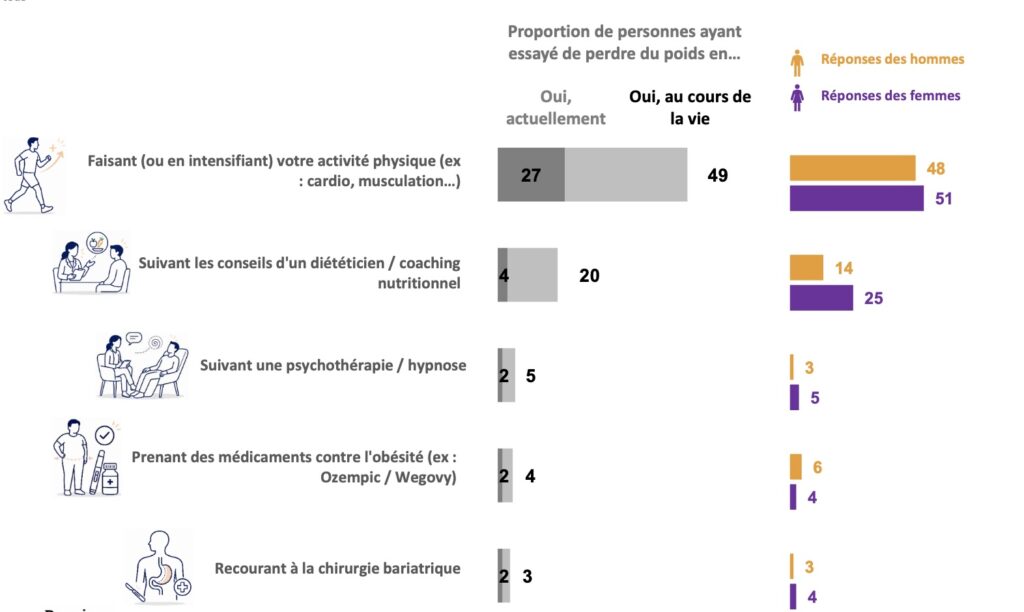
1. Only 4% of French people have already tried to lose weight by taking obesity medications such as Ozempic or Wegovy, and 2% are currently doing so. At the same date, in the United States, 15% of adults said they had already taken them and 11% were taking them at the time of the survey: a ratio of 1 to 4.
2. Rare in the world of weight-loss solutions, anti-obesity medications are the only option more popular among men than women: 6% of men have already taken them versus 4% of women, and up to 10% of men under 35.
3. More generally, the use of weight-loss medications — which is not limited to GLP-1 drugs — appears to be relatively stable over the long term: taking products or medications to lose weight concerns 12% of French people over their lifetime, a level that has remained virtually unchanged since 1979 (11%).
II. But the pool of potential consumers is massive: nearly one in five French people are ready to take these products
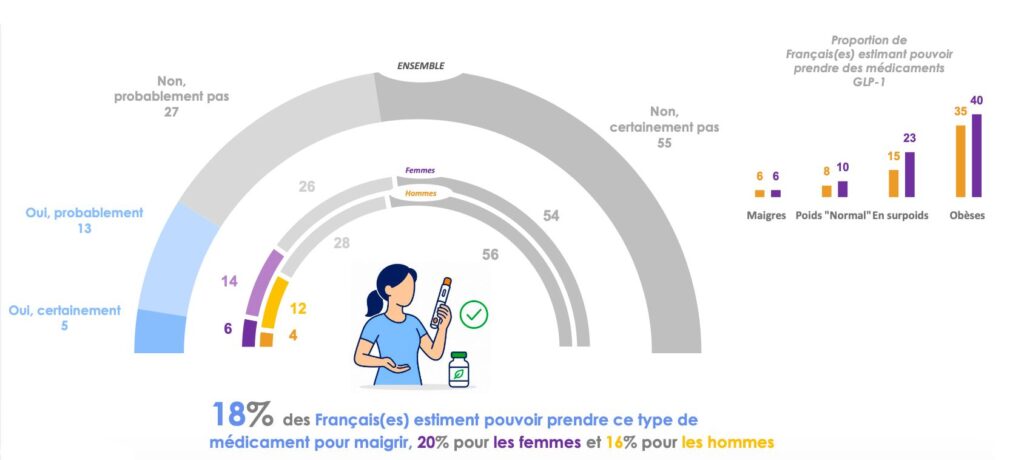
4. 18% of French people believe they could take GLP-1 medications to lose weight (5% “definitely”, 13% “probably”), including 20% of women and 16% of men.
5. Adding current users, the potential market reaches 19% of the population, or nearly ten million adults — a pool of the same order of magnitude as that measured across the Atlantic among non-user Americans (22%).
III. The real risk: a parallel market recruiting precisely where the law excludes
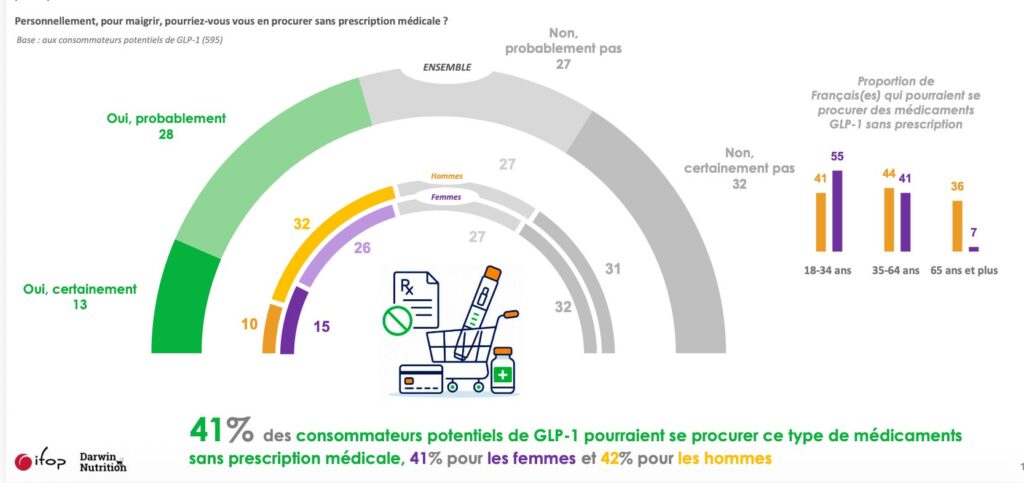
6. 41% of potential GLP-1 consumers could obtain them without a prescription, through foreign pharmacies or unauthorized websites (13% “definitely”), representing about 8% of the adult population — nearly four million people.
7. This recourse to the parallel market follows an inverted gradient: it concerns half of candidates of “normal” build (50% for women, 54% for men), compared with more than a third of people with obesity (38%; 34%), and up to 85% of women who see themselves as thin. In other words, the further one is from reimbursement criteria, the more one considers the illegal option.
8. This black-market clientele is young, urban, and from modest wage-earning backgrounds: 62% of women aged 25-34, 60% of employees, 62% of manual workers, half of residents of the Paris metropolitan area (56% for women, 53% for men), and 61% of daily consumers of beauty content — compared with 7% of women aged 65 and over.
François Kraus, from IFOP, weighs in
Despite a marked difference in use between the United States and France for these medications, the pool of potential users remains similar. The figures seem at first to confirm this differentiated use: only 4% of our fellow citizens have already tried to lose weight with these treatments, compared with nearly four times as many in the United States.
But the reservoir is already there. Nearly one in five French people say they are ready to switch to injections, or about ten million adults — a level comparable to what American institutes measured just before their own takeoff. And this reservoir is filling up in an unexpected place: not first among people with obesity, who are nevertheless within the medical indication, but among those who feel too fat. The way people see themselves predicts interest in GLP-1 better than body mass index does. It is indeed an aesthetic demand, shaped by social media, that is knocking on the pharmacy door.
Hence the most concerning point of this study. Since reimbursement is reserved for severe obesity, the cosmetic part of the demand has nowhere to go — except the black market. Four candidates out of ten are already considering it, and it is precisely the medically least “legitimate” who are most ready to do so: half of people of normal body weight, versus a third of people with obesity. The regulatory framework, designed to protect, indirectly maps out the customer base of unauthorized sites.
Darwin Nutrition’s perspective on the study
“The results of our study are particularly worrying: GLP-1 analogs are indeed medications intended for people with obesity, not weight-loss products. Using them without medical supervision exposes people to deficiencies, loss of muscle mass, almost systematic weight regain when treatment is stopped, and sometimes particularly serious health problems. Except in cases of obesity or overweight with comorbidities, lasting weight loss must first and foremost come through a balanced diet and regular physical activity.”
Quentin Molinié
A. A France still outside the Ozempic wave: only limited use of weight-loss medications
1 – Anti-obesity medications, the last of the weight-loss solutions… and the only masculine one
Only 4% of French men and women have ever tried to lose weight by taking obesity medications such as Ozempic or Wegovy, and 2% are currently doing so. Along with bariatric surgery (3%), it is the rarest weight-loss solution in the entire measured range: far behind eating healthier (66%), physical activity (49%), seeing a dietitian (20%), intermittent fasting (18%), and even fat-burning or appetite-suppressing supplements (15%).
Remarkably, in a heavily female universe, medication is the only weight-loss approach used more by men (6%) than by women (4%), and it peaks among men under 35 (10%). The contrast is clear with meal replacements (12% of women versus 6% of men), appetite suppressants (20% versus 10%), or dieting at least once in one’s life (56% versus 32%).
This French level should be compared with the American trend: across the Atlantic, the same measure of lifetime use rose from 12% in spring 2024 to 18% at the end of 2025. Six points gained in eighteen months: this is not a slow drift, it is a tipping point.
Ifop’s perspective
The medicalization of thinness seems to attract men put off by diet culture, which entails daily discipline and a burden of guilt, but who see medication as a technical and performance-oriented approach much more compatible with the norms of contemporary masculinity.
B. A reservoir of nearly ten million adults: France in 2026 looks like America in 2023
2 – Nearly one in five French people could move to GLP-1
Asked about injectable drugs that suppress appetite and can help people lose 10 to 15% of their body weight, 18% of French people say they could take them to lose weight: 5% “definitely” and 13% “probably.” Adding the 2% who already use them, the potential consumption of GLP-1s stands at 19% of the population — 21% of women, 17% of men — or nearly ten million adults.
This appetite is much younger than current use: it peaks among women aged 35-49 (28%), 25-34 (23%), and 18-24 (20%), before dropping sharply after age 75 (8%). It is also more popular than one might imagine: 26% of female employees and blue-collar workers, 24% of unemployed women and men, compared with 25% of female executives — the appeal is not a privilege of higher socioeconomic groups.
The gender gap is, however, much narrower than in the United States, where stated interest reaches 27% among women versus 18% among men, while France stands at 20% versus 16%. The medication removes the daily discipline and the burden of guilt.
Ifop’s view
The gap between 2% of users and 19% of potential users is the real issue in this study. It should not be read as a forecast of behavior — these are stated intentions regarding an expensive injectable product — but rather as a measure of market potential. What this survey captures is a country where the potential for adoption is considerable, but where use remains strongly constrained by three very concrete barriers: price, prescription access, and the social acceptability of these treatments.
3 – An appeal that tracks with body size, but that browsing beauty content predicts even better
Willingness to take GLP-1 increases dramatically with body perception, in line with body mass index: while only 6% of thin people are willing to take this medication, the figure rises to 16% for women who consider themselves “slim” and 10% for men. About one in five overweight people is ready to use this medication (15% for men, 23% for women), a pattern identical for people who see themselves as “a little too hefty” (21%; 23%), compared with more than one-third for obese people (35%; 40%) and those who consider themselves “really too heavy” (44%; 43%).
Above all, the most discriminating factor across the entire grid is neither weight nor age, but digital exposure: 44% of women who view beauty content on social media every day say they are ready to take GLP-1, compared with 17% of those who view it less often — a gap of nearly 30 points, greater than that produced by actual body size.
Ifop’s view
The gap between these two gradients — BMI and self-assessment — is the statistical trace of a demand that is not a health demand. A previous wave of this observatory showed that 36% of women of normal build consider themselves too fat and that one-third of them want to lose weight before summer. These are the women, medically outside the target group, that GLP-1 is reaching. And it is no coincidence that appeal peaks among consumers of beauty content: the problem and its solution are now served in the same news feed.
4 – The American comparison: same pool, conversion not yet achieved
The usage gap between France and the United States is striking — 4% versus 15% over a lifetime, 2% versus 11% currently — but the gap in willingness is nearly zero. The 22% of non-users in the United States who say they are interested amount, when applied to the whole population, to 20%: exactly the French level. And the hard cores mirror each other: 5% “definitely yes” in France, 7% “very interested” in the United States.
The refusal bloc confirms it: 82% of French people rule out the possibility (55% “definitely not,” 27% “probably not”), a proportion very close to that observed across the Atlantic. The French are no more likely to refuse than Americans — they just consume much less.
François Kraus’s perspective from Ifop
Structurally, France in May 2026 looks like the United States in 2023: the same pool of potential users, but conversion has not happened. What separated the two countries was therefore not a difference in mindset, but a difference in access — price, prescription, lack of an organized distribution network. Yet that situation was captured one month before reimbursement took effect: it is the starting point of a series that will need to be repeated in order to measure, this time, what becomes of a pool when the floodgates are opened.
C. The real risk: a parallel market that recruits precisely where regulation excludes
5 – Four in ten potential consumers are willing to go without a prescription
Asked about the existence of a parallel market — foreign pharmacies, unauthorized websites selling without a prescription — 41% of potential GLP-1 consumers say they could obtain it there: 13% “definitely” and 28% “probably.” Relative to the total population, that represents about 10% of adults, or nearly four million people. And for once, men (42%) are no different from women (41%).
The more you have a medical credential to access legally, the less you consider bypassing it; the more excluded you are, the more the gray market appeals. Indeed, among GLP-1 candidates, those with the lowest body weight are the most likely to consider the prescription-free route: half of candidates with a “normal” build (50% for women, 54% for men) and 56% of thin women, compared with more than a third of people with obesity (38%; 34%). The same reversal is seen in the feeling of having extra pounds: 70% of women who say they have none consider buying without a prescription, compared with 41% of those who do and would like to lose them before summer.
A young, urban black-market clientele drawn from modest wage earners. The willingness to buy without a prescription rises to 62% among women aged 25-34 and 46% among those aged 18-24, and to 53% among men and 56% among women in the Paris metropolitan area (compared with 27% and 42% in rural municipalities). Socially, the appeal peaks among employees (60%), manual workers (62%), and female managers/executives (55%), that is, among wage earners with enough purchasing power to consider spending a few hundred euros. Finally, digital exposure is once again a major factor: 61% of daily female consumers of beauty content consider buying without a prescription, compared with 37% of those who consult it less often.
Ifop’s perspective
Here we have the composite portrait of a gray market to come: a woman under 35, employed or a manual worker, urban, without declared obesity, and highly exposed to beauty content. This is not a marginal profile; it is a mass profile.
TO CITE THIS STUDY, THE FOLLOWING WORDING MUST BE USED AT MINIMUM:
“Ifop study for Darwin Nutrition conducted by an online self-administered questionnaire from May 17 to 21, 2026, among a sample of 3,004 people, representative of the French population aged 18 and over.”
About Darwin Nutrition
Darwin Nutrition is an independent media outlet dedicated to nutrition, founded in 2019. Its editorial team is made up of health and food professionals, scientists, and specialized authors.
Darwin Nutrition also produces the podcast Food Revolutions! devoted to political and sociological issues surrounding food.
Press contacts
François Kraus (Ifop) – Tel.: 06 61 00 37 76 – francois.kraus@ifop.com
Léo Major (Ifop) – Tel.: 01 72 34 94 42 – leo.major@ifop.com
Quentin Molinié (Darwin Nutrition) – quentin@darwin-nutrition.fr
Francis Aubouin (IFOP-ISSEO) – Tel.: 06 88 09 76 70 – francis.aubouin@ifop.com
