

BENEFITS OF SOY
✓ Source of plant-based protein
✓ Reduces cholesterol
✓ Supports bone health
✓ Improves menopause symptoms
✓ Protects the heart
What is soy?
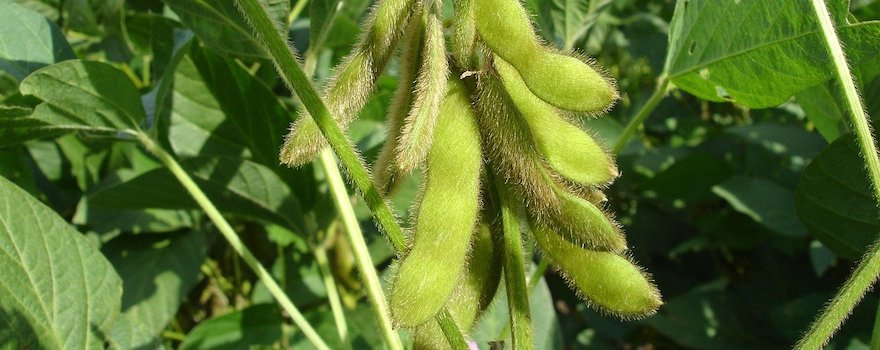
Like lupin, lentils or fenugreek, soy (Glycine max) is a legume in the Fabaceae family. Reaching up to 1.3 m in height, it produces hairy pods that contain up to 4 seeds. These are the ones that are harvested, eaten as is or processed.
Originally from Asia, it is thought to have been cultivated for the first time in China, 3,000 to 5,000 years ago. Gradually, the plant was introduced to Japan, Europe, and then the United States, which are today the world’s leading producer.
Soy consumption experienced a real resurgence in the 1990s. Presented as a healthy and nutritious food, it appeals to people concerned about their health and wishing to reduce or eliminate their meat consumption.
It is one of the best-known alternatives for replacing meat in a vegetarian or vegan diet. Indeed, it has a high content of plant-based protein and contains all essential amino acids. Soybeans also contain fiber, fatty acids, vitamins, minerals, and trace elements.
Extensively studied, it offers numerous health benefits. In addition to being an excellent source of protein, it lowers cholesterol, supports bone health, and improves menopausal symptoms. It is also recognized for its cardioprotective effect.
Soy now ranks 7th among the world’s main agricultural commodities. About 70 % of production is intended for animal feed and processed into soybean meal. In recent years, it has experienced phenomenal growth, notably in South America. Unfortunately, this development has had a heavy impact on the environment : along with palm oil, soy contributes greatly to deforestation, which is why it is important to carefully control its origin.
Nutritional composition
- 18 acides aminés
- Vitamines : pro-vitamine A, B1, B2, B3, B5, B6, B8, B9, E, K
- Minéraux et oligo-éléments : calcium, chlore, cuivre, fer, magnésium, manganèse, phosphore, potassium, sodium, zinc
- Lipides
- Protéines
- Glucides
- Fibres
- Acides gras : oméga 3-6-9
- Actifs antioxydants : isoflavones
Benefits of soy
🌿 Source of plant-based protein
With 38 g per 100 g, soy is among the best sources of plant-based protein. It is therefore a particularly valuable food for reducing or even eliminating animal proteins from one’s diet.
The proteins it contains also have the advantage of being complete, meaning they contain all the essential amino acids for the human body. These notably include valine, phenylalanine, leucine and the valuable tryptophan.
This review from Loyola University Chicago Stritch School of Medicine (United States) studied the composition of soy and its protein content.
Also read Our tips for buying plant proteins
🍳 Reduces cholesterol
Soy helps lower blood cholesterol levels. It notably reduces the level of LDL cholesterol (or “bad cholesterol”) that deposits on the vessel walls and leads to arterial blockage.
This effect is largely due to the isoflavones it contains. In addition to fighting free radicals, these molecules lower blood lipid levels, including cholesterol and triglycerides.
This study from the National Institute of Health and Nutrition in Tokyo (Japan), conducted in humans, shows the benefits of soy on cholesterol levels.
🦴 Supports bone health
Soy isoflavones also have a beneficial effect on bone health. They improve bone mineral density (BMD) and bone remodeling for strong, resilient bones. This legume is particularly studied as a potential agent in the prevention and treatment of osteoporosis, a skeletal disease linked to aging.
This study from the National Institute of Health and Nutrition in Tokyo (Japan), conducted in postmenopausal women, shows how soy can prevent osteoporosis and improve bone strength.
🌺 Improves menopause symptoms
Soy isoflavones are not only antioxidants. They are also natural phytoestrogens and have effects similar to female hormones (estrogens).
This legume contains three major isoflavones called genistein, daidzein and glycitein. These compounds raise estrogen levels that drop at menopause and reduce symptoms associated with hormonal change such as hot flashes.
This study from the University of Ferrara (Italy), conducted in postmenopausal women, shows how soy reduces the frequency of hot flashes.
❤️ Protects the heart
Soy has a beneficial effect on the heart. On the one hand, it reduces cardiovascular risk factors such as hypercholesterolemia, atherosclerosis, or high blood pressure. On the other hand, it supports heart function and improves vasodilation.
The fiber and fatty acids it contains also contribute to cardiovascular health and disease prevention.
This review from the Guelph Research and Development Centre (Canada) highlights the mechanisms of action of soy in preventing cardiovascular disease.

Is soy a health risk ?
For many years, soy has been the subject of controversy because of its phytoestrogen content. These compounds are accused of causing hormonal imbalances in non-menopausal women. In addition, because it reduces iodine absorption, it can cause thyroid dysfunction.
But these negative effects occur only in cases of excessive consumption. If you want to replace meat on your plate, eat it in reasonable amounts and vary your sources of plant-based proteins : grains, legumes…
How to consume soy?
Soy-based preparations
There are many soy-based products. They come as milk, flour, sprouts, soy sauce, soy protein or vegetable oil. It can also be consumed in the form of:
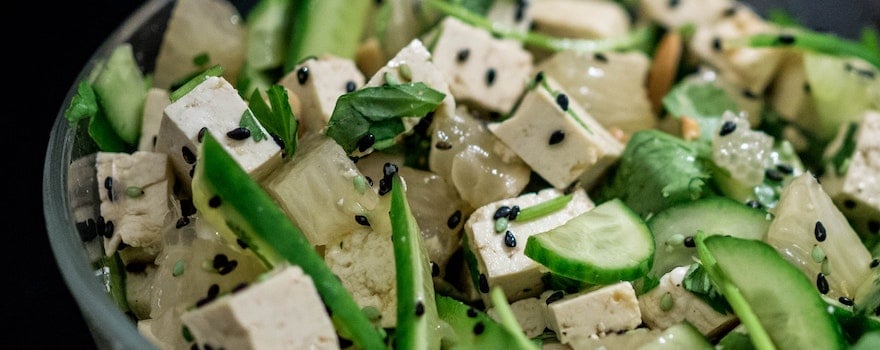
- tofu, une pâte blanche issue du caillage du lait de soja. Il peut être ferme (vendu sous forme de galettes ou de cubes) ou soyeux (à la texture plus souple et granuleuse)
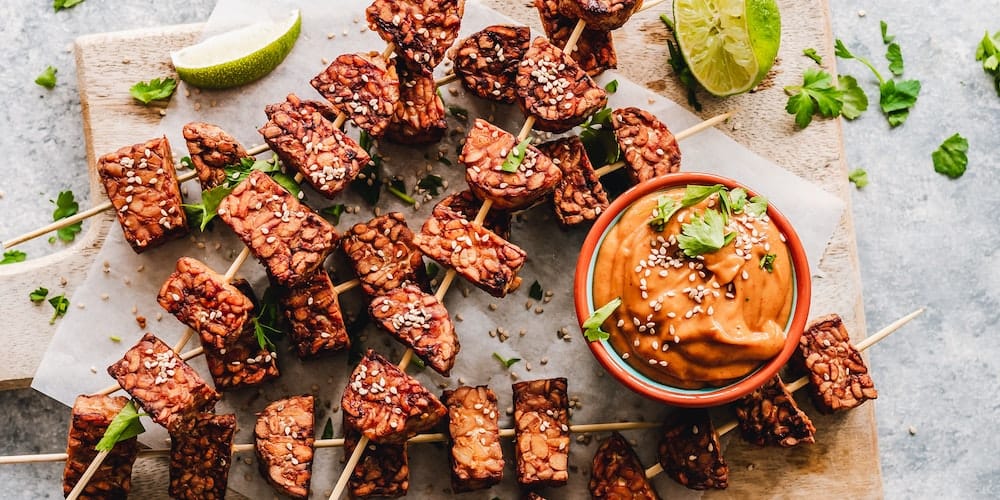
- tempeh, une spécialité culinaire fabriquée à partir de graines de soja cuites, écrasées et fermentées
- miso, un aliment traditionnel de la cuisine japonaise obtenu à partir de pâte de soja fermentée.
Vegetarians and flexitarians will enjoy soy steaks, tofu-based vegetarian sausages or nuggets made from soy protein. All are original and tasty alternatives to meat.
Soy flour
Little known, soy flour nonetheless has flavorful and nutritional qualities. Once harvested, the soybeans are ground into powder to obtain a fine, pale yellow flour. Like rice flour, buckwheat or quinoa flour, soy flour is naturally gluten-free. It is therefore suitable for people who are intolerant, allergic, or sensitive to gluten.
Soy flour has a slightly bitter taste. If you don’t like it, opt for toasted soy flour with a nutty flavor, milder and sweeter. This flour is used to make breads, pasta, cakes, vegetarian patties… It also helps thicken and bind sauces, and can replace butter and eggs.
Soy lecithin
The soy lecithin is an emulsifying or stabilizing agent used as an additive in many processed foods. It’s a byproduct of soybean oil, which contains choline, beneficial for the heart and liver, and has good anti-cholesterol properties.
It is also available as a dietary supplement. In that case, you should be cautious about its origin because it may be derived from GMOs.
Consume sustainably: prioritize organic, local, and fair-trade soy
✓ Global soybean production is split between the United States, Brazil, and Argentina. France, for its part, has about 155,000 hectares of soy and its cultivation continues to grow. It is mainly grown in the southwest and east of France but also in Brittany, as here in Finistère.
✓ If you can, favor non-GMO soy, grown in France and organically farmed. Also choose fair-trade products to support the work of small farmers.

Dosage
It is recommended to consume about 30 g of soy per day.
Contraindications and side effects
Soy consumption has certain contraindications :
- Par mesure de précaution, il est déconseillé aux femmes enceintes et allaitantes et aux jeunes enfants ;
- Les personnes souffrant d’hyperthyroïdie doivent éviter d’en consommer ;
- En raison de sa teneur en isoflavones, sa consommation est déconseillée aux personnes ayant des antécédents personnels ou familiaux de cancers hormono-dépendants.
Excessive consumption can have certain side effects :
- Troubles gastro-intestinaux
- Nausées
- Réaction allergique
If you experience side effects, stop consuming it and consult a doctor.
Report by Julia Perez
Sources and scientific studies
Gyoung-Ah Lee, Gary W. Crawford, Li Liu, Yuka Sasaki, Xuexiang Chen. 2011. Archaeological Soybean (Glycine max) in East Asia: Does Size Matter?
Aaron J Michelfelder, 2009. Soy: a complete source of protein.
Kyoko Taku, Keizo Umegaki, Yoko Sato, Yuko Taki, Kaori Endoh, Shaw Watanabe, 2007. Soy isoflavones lower serum total and LDL cholesterol in humans: a meta-analysis of 11 randomized controlled trials.
Kyoko Taku, Melissa K Melby, Nobuo Nishi, Toyonori Omori, Mindy S Kurzer, 2011. Soy isoflavones for osteoporosis: an evidence-based approach.
P Albertazzi, F Pansini, G Bonaccorsi, L Zanotti, E Forini, D De Aloysio, 1998. The effect of dietary soy supplementation on hot flushes.
