

We analyzed 13 brands of wet cat food and selected 3 products.
All the wet foods we selected are made entirely in France, are grain-free, and meet recommended nutrient levels.
QUALITY / PRICE
Grain-free cat pâté
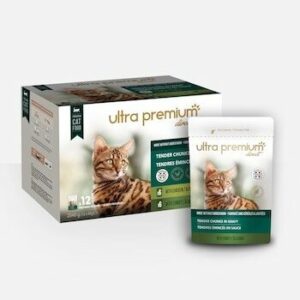
Ultra premium
PREMIUM
Wet food for spayed/neutered cats
Ziggy
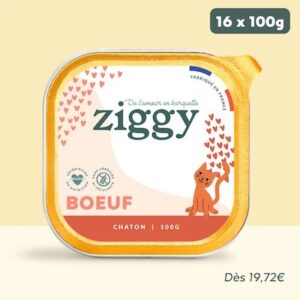
FOR KITTEN
Kitten beef pâté
Ziggy
Our selection criteria
- % protein: this is the protein content of the cat pâté. It should be at least 10%.
- % fat: this is the pâté’s fat content. It should be limited for sterilized and/or overweight cats.
- RPP: the protein-to-phosphorus ratio is a good indicator of the proportion of meat to carcass. The higher it is, the better.
- Price / 100 g: this is the price per 100 g of wet food.
- Customer reviews: this average of customer reviews for the brand comes from the brand’s website, review platforms, or marketplaces like Amazon.
BEST VALUE FOR MONEY
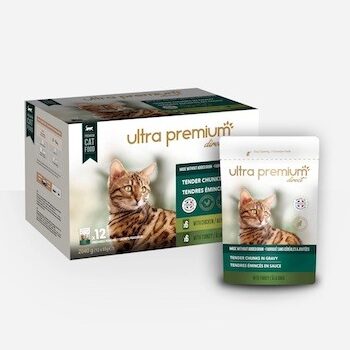
Brand : Ultra Premium Direct
% protein : 9.5%
% fat : 4.5%
RPP : 79.2
Price / 100 g : €0.73
Customer reviews : 4.7/5 (avis-verifies.com)
We selected this pâté for sterilized cats for the quality of its nutritional composition and its excellent value for money.
The protein content and the RPP indicator are good, and the fat percentage is particularly low.
This pâté made in France contains chicken and turkey and comes in freshness pouches. It is suitable for all cats, sterilized or not.
Ultra Premium Direct is a recognized French company in the pet food market founded in 2014. This brand has democratized access to high-quality cat food thanks to the absence of intermediaries between the factory and the consumer.
By subscribing, you receive a 10% discount.
BEST PREMIUM
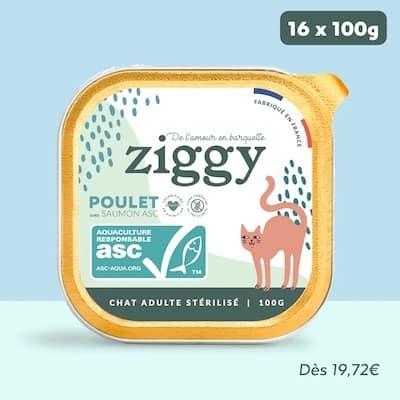
Brand : Ziggy
% protein : 10%
% fat : 6%
RPP : 109.6
Price / 100 g : €1.45
Customer reviews : 4.8/5 (ziggy-family.com)
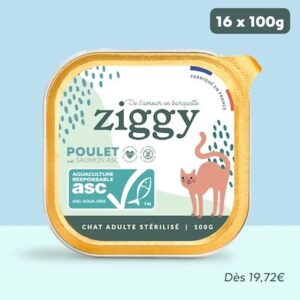
The Ziggy brand offers a pâté for sterilized adult cats with an excellent nutritional profile.
It has the highest protein-to-phosphorus ratio in our comparison, a sign of the use of good-quality meat pieces with few bones and little cartilage.
Made of chicken, pork and ASC salmon fillets (responsible aquaculture), this pâté contains 10% protein and little fat. It is therefore suitable for neutered cats, and more broadly for cats prone to gaining weight.
Ziggy is a young cat food brand based in Bordeaux. All products are made in France, with recipes developed by a veterinarian nutritionist renowned worldwide for her expertise in clinical nutrition.
By subscribing, you receive a 15% discount and €10 off on the first month.
BEST WET FOOD FOR KITTENS
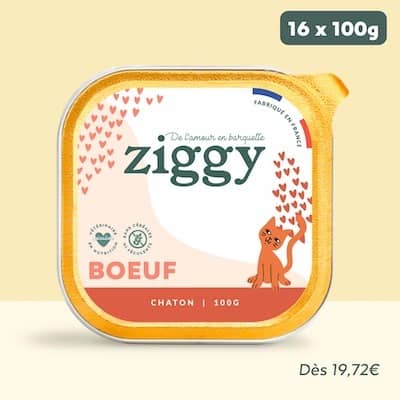
Brand : Ziggy
% protein : 11.3%
% fat: 10%
RPP : 84.9
Price / 100 g : €1.45
Customer reviews : 4.8/5 (ziggy-family.com)
Ziggy’s kitten wet food is an excellent choice given the quality of the ingredients used and its nutritional profile.
It is very high in protein (11.3%) and has a fat content appropriate for this life stage.
Enriched with vitamins and minerals, this beef wet food is suitable for kittens from weaning up to 12 months.
Ziggy is a young cat food brand based in Bordeaux. All products are made in France, with recipes developed by a veterinarian nutritionist renowned worldwide for her expertise in clinical nutrition.
By subscribing, you receive a 15% discount and €10 off on the first month.
What are the advantages of wet cat food?
Wet cat food is a complete commercial food that contains all the nutrients necessary for your pet’s good health.
When it is of good quality, it is a guarantee of longevity and well-being for your companion.
The essential difference between kibble and wet cat food is their water content: less than 14% for dry food versus 70 to 80% for wet food.
READ ALSO | Best cat kibble: our buying guide
Cat food helps ensure better urinary health
Cats don’t drink much. Consequently, their urine is very concentrated and tends to ‘sediment’, forming either stones or small clumps composed of minerals and proteins.
This can result in cystitis and, especially in males, very serious urinary obstructions.
This phenomenon is further exacerbated in animals fed exclusively on kibble because of the negligible moisture content of that food.
Canned cat food, with its water content above 70%, provides better hydration and beneficial dilution of the urine.
It is now considered dangerous to feed a cat exclusively on dry food.
The water contained in wet cat food contributes to your companion’s urinary health and well-being by helping to prevent painful conditions and stressful veterinary visits and hospitalizations!
Wet cat food provides better satiety
Because of its greater volume, wet food leads to a greater stomach fullness that sends a satiety signal to the brain, stopping the feeling of hunger and therefore food intake.
An interesting property for limiting overweight in sedentary and neutered pets.
This point is far from trivial, since about one in three cats is affected by obesity, a condition involved in many disorders (diabetes, hepatic lipidosis, osteoarthritis, lower urinary tract disease…).
A wide variety of options
Whether it’s in terms of texture or scent, your kitty will have plenty to choose from!
Indeed, you can find wet food itself but also meatballs, slices, mousses, stews, terrines…
There are also options for all tastes, from the classic “chicken” to the more briny “seafood”, and even the mild “rabbit”!
Better palatability
The strong smell and bolder taste of wet cat food are not lost on our little gourmets.
This quality can be used to feed a weak or elderly cat, or simply a picky eater.
An interesting mix with kibble
Finally, canned cat food is the ideal complement to dry food.
The kibble/wet-food mix is the diet that best meets both the dietary and behavioral needs of the cat.
Currently, the mix recommended by veterinary nutritionists is some wet food in the morning and evening for hydration and taste, and some kibble throughout the day for snacking and dental health.
For quantities, they vary depending on the brand, the composition and the cat’s weight. It’s best to refer to the packaging.
As a guideline, Hill’s recommends 300 g/day for a 4 kg adult cat, or 85 g + 40 g of kibble. The goal is to maintain the animal’s ideal weight.
What criteria should you consider when buying wet cat food?
It’s not always easy to navigate the many pet food brands. Here are a few tips for choosing the right wet food for your cat.
The composition
As a strict carnivore, the cat needs a diet rich in protein. But not just any protein; you should favor animal-based proteins, such as meat, fish or eggs.
Quality proteins provide the eleven essential amino acids that cannot be synthesized by the cat’s body, such as taurine, whose deficiency can lead to heart problems.
The protein content in a can should be between 7% and 15% (this range is due to variation in moisture content)
Other ingredients include vegetables in small amounts, fats including fatty acids (notably for coat health), vitamins, and minerals (calcium, sodium, phosphorus, potassium, magnesium) without excess.
Specifically, on the labels, you should look for the following percentages:
- A high protein level, above 7%
- A low carbohydrate (sugars) level, below 2%
- A fat (lipid) level of around 5%
- A crude fiber level below 1.5%
- A crude ash (minerals) level below 2.5%, with a phosphorus level below 1.1%
- A protein-to-phosphorus ratio above 35
This last point, the protein-to-phosphorus ratio or PPR (which you will have to calculate yourself; it is the percentage of protein divided by the percentage of phosphorus in the food), is a good indicator of the quality of the proteins included in cat food.
Indeed, good-quality protein ingredients (meat, fish…) have a high RPP, while low-end ones (carcass, bones, cereals…) have a low RPP.
The phosphorus level is generally indicated on the labels of cans from reputable pet food manufacturers.
Sanitary standards
Wet food is a more fragile product than dry food. It must meet precise manufacturing standards and be subject to regular checks.
To find out if the manufacturer complies with current nutritional and health regulations, you can check that it is a member of FEDIAF (European Pet Food Industry Federation) or FACCO (Federation of Manufacturers of Food for Dogs, Cats, Birds and Other Companion Animals).
Pet food manufacturers that are members of these organizations commit to following a code of good practices.
Once opened, cat cans can be stored in the refrigerator for a maximum of 2-3 days. But they may become less appealing…
Price
Watch out for low prices. Good ingredients are expensive ! Quality wet food is not cheap.
Professional advice
If you’re unsure, don’t hesitate to ask your veterinarian for advice, who knows the pet food market and, above all, knows your cat!
Commercial pet food allows an almost personalized diet based on age, but also on your cat’s health condition.
You’ll find special kitten or senior cans, as well as pâtés to help an overweight animal lose weight or to soothe a cat suffering from digestive or skin sensitivities.
Manufacturers of veterinary ranges also sell wet food for cats suffering from kidney disease or diabetes, for example.
What are the best wet foods for kittens?
The kitten (1 to 8 months) is in a phase of rapid growth. It has very specific nutritional needs to support its development.
Kitten cans are higher in protein, contain more calcium, and are higher in calories.
Wet food suitable for very young kittens (1 month) is available at the time of the introduction of solid foods.
There are also cans for neutered kittens (around 6 months).
They help the animal complete its growth harmoniously without gaining excessive weight thanks to a reduced fat content.
What are the best wet foods for spayed or neutered cats?
Male and female cats are usually neutered around the age of 6 months.
Spaying/neutering causes hormonal changes. Combined with a certain lack of activity (a cat that goes out little or not at all), it can promote weight gain.
If left unchecked, this excess weight can, over the years, lead to obesity. That’s why manufacturers have developed specific diets for spayed/neutered cats.
These wet foods for neutered cats are characterized by a reduced fat content and the addition of fiber for satiety.
For example, within the same line, the fat content can range from 5.2% in regular cans to 3.4% in the sterilized-cat version. Crude cellulose (fiber) rises from 0.6% to 1.1%.
Where to buy wet cat food?
You have several channels to source cans for your cat.
From veterinarians
They offer premium veterinary ranges. You can trust them implicitly.
Some clinics offer online shops at reduced prices with a click-and-collect system.
In pet stores
They sell various brands, including those found in veterinary clinics, and also have online stores.
In supermarkets
Quality varies. It is preferable to avoid low-cost ranges. As we saw above, good ingredients are expensive!
Online
There is a very wide selection, with both good and less good options.
On the web, it’s sometimes hard to navigate, and trusting attractive packaging or a slick marketing line isn’t necessarily wise.
Before ordering, check the site’s reliability and its country of origin. Standards are not the same in every country.
Also think about your carbon footprint when ordering cans manufactured on another continent!
You can also look for quality labels such as a manufacturer’s membership in FEDIAF or FACCO.
Are canned foods responsible for diarrhea in cats?
Because of its high water content, wet food is sometimes blamed for causing diarrhea.
A high-quality food should not cause this kind of problem, whether dry or wet.
An episode of loose stools following the introduction of a wet cat food may be due to:
- From a dietary transition that is too rapid
- From low-quality or poorly stored cans
- From an underlying condition; if diarrhea persists after stopping the new food, it is advisable to consult your veterinarian
To summarize
A quality wet cat food:
- Is rich in animal protein
- Has a RPP greater than 35
- Has one or more quality labels
- Has a reduced fat percentage if your cat is spayed or neutered
- Can be mixed with kibble!
- Is usually purchased through specialty retailers
QUALITY / PRICE
Grain-free cat pâté
Ultra premium
HIGH-END
Sterilized cat pâté
Ziggy
FOR KITTENS
Beef kitten pâté
Ziggy
When you buy the selected products, a commission may be paid to us to help run the site, pay our writers, and ensure you receive quality information. This does not affect prices.
