

BENEFITS OF CRANBERRY
✓ Prevents urinary tract infections
✓ Protects the heart
✓ Fights bacteria
✓ Improves oral health
What is cranberry?
The cranberry (Vaccinum macrocarpon) is also called “grande airelle ” or ” cranberry “. It belongs to the Ericaceae family like the blueberry or the arbutus.
Native to North America, the plant grows wild in peat bogs. It is also cultivated in sandy fields called ” cranberry bogs “. In September-October, they are flooded to allow ripe fruit to float and be harvested more easily. The United States and Canada are the world’s main producers.
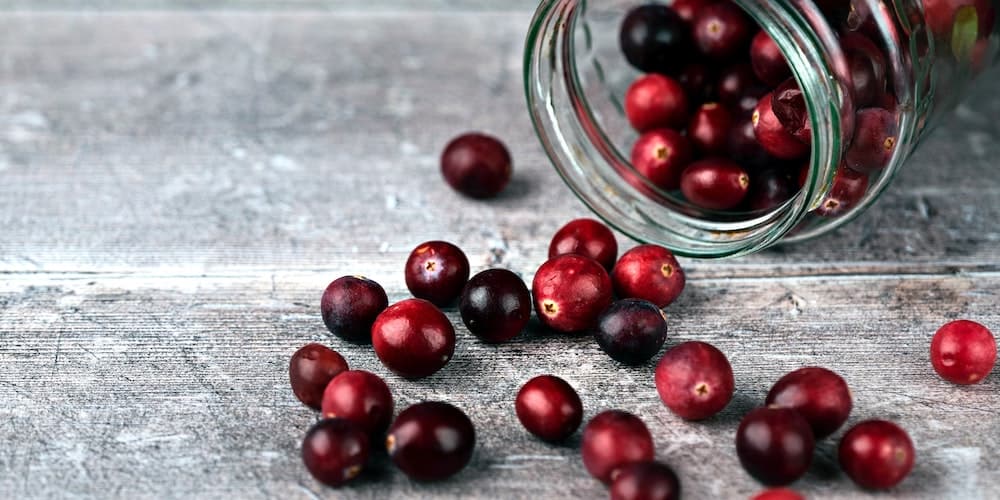
The red berries are valued for their tart flavor. They are eaten fresh or dried, and are used to make juice, jam, cakes…
Beyond their taste qualities, they also have health benefits. They help protect the urinary system and can prevent certain infections such as cystitis.
Also read The best dietary supplements for urinary tract infections
Their consumption is also beneficial for the cardiovascular system. Finally, cranberries are antibacterial and support oral health.
Nutritional composition
- Acides aminés
- Vitamines : B5, B6, C, E, K1
- Minéraux et oligo-éléments : potassium, phosphore, calcium, magnésium, cuivre, fer, manganèse
- Glucides
- Fibres
- Protéines
- Lipides
- Actifs antioxydants : anthocyanosides, flavonoïdes, polyphénols
- Acides organiques : acide ursolique, acide quinique, acide benzoïque
- Tanins : proanthocyanidols, épicatéchols
- Eau
Benefits of cranberry
🌸 Prevents urinary tract infections
Its consumption is useful for preventing urinary tract infections. It notably reduces the risk of cystitis in women.
The berries contain proanthocyanidins. These flavonoids prevent adhesion to the urinary tract walls of bacteria responsible for infections such as Escherichia coli. Unable to attach to the mucous membrane, they are flushed out in the urine.
In addition, cranberry acidifies the pH of urine. This acidic environment prevents pathogenic bacteria from developing.
This review shows the effectiveness of cranberry in preventing urinary tract infections.
❤️ Protects the heart
Cranberry has beneficial effects on the cardiovascular system. It protects the heart and prevents certain diseases such as atherosclerosis. To this end, it reduces risk factors for heart disease.
Its antioxidant polyphenols, for example, lower levels of bad cholesterol (LDL cholesterol) and increase levels of good cholesterol (HDL cholesterol).
In addition, they reduce platelet aggregation and lower blood pressure.
Finally, cranberry supports cardiovascular health through antithrombotic and anti-inflammatory mechanisms.
This review focuses on its effect on cardiovascular risk factors.
🦠 Fights bacteria
Thanks to its antibacterial action, it can reduce the growth and concentration of pathogenic bacteria.
It has been shown to be particularly effective against the bacterium Helicobacter pylori, which is responsible for gastric ulcers and stomach cancer.
This study from Peking University, conducted on adults, shows the antibacterial activity of cranberry juice against Helicobacter pylori.
👄 Improves oral health
Cranberry consumption contributes to oral health and oral hygiene. That’s why it is found in many products : toothpaste, gel, paste…
On the one hand, its antibacterial action prevents certain bacteria from adhering to the mucous membranes of the mouth. It creates a protective biofilm against pathogens.
On the other hand, it prevents the development of cavities by the bacterium Streptococcus mutans.
Finally, it can relieve the inflammation of the gums such as gingivitis and periodontitis.
This review examines its beneficial effects on oral health.
How to consume it?
As fresh or dried berries
Cranberries are available fresh or dried. They can be eaten as is if you enjoy their tart flavor.
You can also add them to your sweet recipes (cakes, jam, jelly…) and to your drinks (tea, herbal tea, smoothie…). They also pair well with meat and poultry (turkey).
As juice
It is possible to find pure cranberry juice, made from 100 % berry juice. There are also cocktails where cranberry is mixed with other fruits : apples, grapes, raspberries…
In that case, you should choose a beverage containing at least 25% cranberry juice to enjoy its benefits.
In capsules
Capsules are taken as a dietary supplement, particularly for urinary comfort. They contain dehydrated juice or berry powder.
Choose capsules with a high content of proanthocyanidins (at least 35 mg per capsule).
They should be non-GMO, additive-free, and free of excipients.
Choose organic cranberry
Cranberry plants are susceptible to diseases and pests, and therefore often receive chemical treatments.
If possible, choose fruit grown through organic farming. This guarantees no pesticide residues and cultivation that respects the environment.
Also favor berries hand-harvested, from artisanal and sustainable cultivation.
Dosage
The recommended average dosage is 500 ml of juice per day or 300 to 1500 mg per day for capsules.
Contraindications and side effects
Its consumption has certain contraindications :
- Par mesure de précaution, elle est déconseillée aux femmes enceintes et allaitantes ;
- En raison de la présence d’oxalates, les personnes souffrant de calculs rénaux doivent éviter d’en consommer ;
- Les personnes en surpoids ou diabétiques doivent en consommer avec modération ;
- La canneberge peut interagir avec certains médicaments comme les anticoagulants. Demandez conseil à votre médecin si vous suivez un traitement.
Its consumption has certain side effects :
- Maux d’estomac
- Diarrhée
- Ballonnements
If you experience side effects, stop taking it and consult a doctor.
Sources and scientific studies
RG Jepson, J C Craig, 2008. Cranberries for preventing urinary tract infections.
Diane L McKay, Jeffrey B Blumberg, 2007. Cranberries (Vaccinium macrocarpon) and cardiovascular disease risk factors.
Lian Zhang, Junling Ma, Kaifeng Pan, Vay Liang W Go, Junshi Chen, Wei-cheng You, 2005. Efficacy of cranberry juice on Helicobacter pylori infection: a double-blind, randomized placebo-controlled trial.
C Bodet, D Grenier, F Chandad, I Ofek, D Steinberg, E I Weiss, 2008. Potential oral health benefits of cranberry.
