

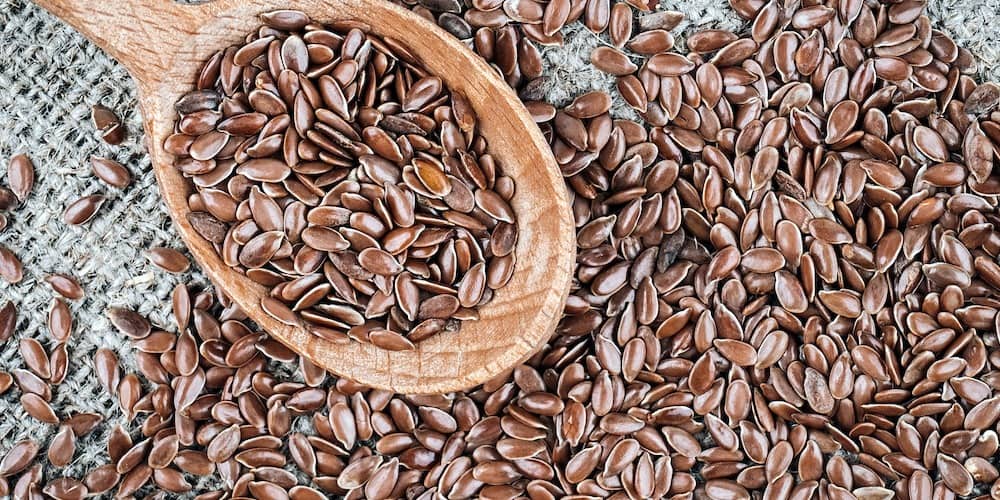
BENEFITS OF FLAX SEEDS
✓ Support cardiovascular health
✓ Improve digestion
✓ Help with weight loss
✓ Reduce cholesterol levels
✓ Improve diabetes management
What are flax seeds?
Flax seeds are harvested from the plant Linum usitatissimum or ‘cultivated flax’, belonging to the Linaceae family. Originally from the Caucasus, it later spread to Asia, India, Egypt and then Europe.
Like hemp, this variety of flax is cultivated for its textile fibers, extracted from the stem, and also for its oilseeds.
Cultivated for about 9,000 years, flax can reach 1 m in height. In mid-June, it produces sky-blue flowers that attract many pollinators. After flowering, the plant sets seed and forms capsules. Each of them contains several thin, flat seeds.
Once the stems are dry and browned, the seeds have reached maturity and are ready to be harvested. They are then consumed as-is, finely ground to make flour, or pressed to produce a vegetable oil.
Flax seeds are particularly rich in fatty acids (omega-3-6-9), which account for 40 % of their composition. They also contain plant proteins, fiber, vitamins, minerals and trace elements.
Studied since the 1980s, they have many benefits for the body. They notably contribute to cardiovascular health, improve digestion and promote weight loss. They also lower cholesterol levels and help control diabetes.
Cultivated flax is a plant whose almost all parts can be used for industrial, food, fodder, and fiber purposes. A large part of global production is intended for flax fiber cultivation. Like hemp or nettle, the fibers from the stems are then used to make natural textiles.
As such, France is the world leader in textile flax production. Upper Normandy alone accounts for 50% of the world’s flax fiber production.

Nutritional composition
- Acides aminés
- Vitamines : B1, B2, B3, B5, B6, B9, E
- Minéraux et oligo-éléments : calcium, cuivre, fer, magnésium, phosphore, potassium, sodium, zinc
- Protéines
- Fibres
- Glucides
- Lipides
- Acides gras : oméga-3-6-9
- Polyphénols : lignanes
Benefits of flax seeds
❤️ Support cardiovascular health
Les graines de lin sont source de « bonnes graisses ». Elles contiennent entre 35 et 45 % d’huile, elle-même composée d’acides gras saturés (palmitique et stéarique), monoinsaturés (acide oléique) et polyinsatuturés (acide alpha-linolénique). Il s’agit d’oméga 3-6-9 qui contribuent à la santé du cœur et à la prévention des maladies cardiovasculaires.
Lira aussi | Nos conseils pour acheter des oméga-3
With 17 g per 100 g, they are one of the most abundant sources of omega-3. Omega-3 regulates blood pressure, improves the elasticity of blood vessels and prevents platelet aggregation.
Omega-6 and omega-9, for their part, reduce the level of bad cholesterol that tends to accumulate in the arteries.
This review from the University of Manitoba (Canada) focused on flaxseeds and their benefits for the heart.
♻️ Improve digestion
Flaxseeds are among the best dietary high-fiber foods. Indeed, they contain about 27 g of fiber per 100 g including soluble fiber. As with the chia seeds, these are mucilaginous fibers.
By swelling on contact with water, these fibers regulate intestinal transit, ease the passage of stools and improve their consistency. Flaxseeds thus act as a gentle laxative and relieve transit disorders such as constipation.
This study from the Isfahan University of Medical Sciences (Iran), conducted in constipated patients, demonstrates the effectiveness of flaxseeds in improving intestinal transit.
🏃🏻♂️ Help with weight loss
Consuming flaxseeds is useful to support weight loss. Thanks to their high soluble fiber content, they have a satiating effect and act as a natural appetite suppressant.
By slowing digestion and forming a viscous gel in the stomach, their fibers promote a feeling of fullness. Thus, they reduce snacking between meals. In addition, their beneficial effect on transit improves the elimination of the body’s waste and helps achieve a flat stomach.
Finally, they contain about 20 g of plant protein per 100 g. These nutrients increase satiety, boost metabolism and fat burning.
This study from Tehran University of Medical Sciences (Iran), conducted in overweight and obese patients, shows how consuming flax seeds promotes weight loss.
🍳 Reduce cholesterol levels
Flax seeds help reduce blood cholesterol levels. Regular consumption notably lowers the level of LDL cholesterol (or “bad” cholesterol) and increases HDL cholesterol (or “good” cholesterol).
This action is due to soluble fibers but also to the lignans they contain. These are phenolic compounds with a hypolipidemic effect, meaning they reduce lipids (cholesterol and triglycerides) in the blood. They trap and decrease the absorption of cholesterol in the intestine.
This study from the Autonomous College of Gwalior (India), conducted in humans, shows how flax seeds reduce cholesterol levels.
🍭 Improve diabetes management
Thanks to their high content of soluble fiber and lignans, flax seeds help control diabetes and lower blood glucose levels. In addition, they limit post-meal blood sugar spikes and improve insulin resistance.
This study from the University of Saskatchewan (Canada), conducted in rats, shows the beneficial effects of flax seeds on diabetes.

How to consume flax seeds?
Whole flax seeds
This is the easiest form to find and consume. Whole flax seeds have a slightly nutty flavor. They can be enjoyed as is or added to various savory or sweet recipes: breads, cakes, salads, vegetable dishes, smoothies and health drinks… They can also be ground to aid absorption.
There are brown flax seeds and golden flax seeds. The latter are slightly higher in plant protein and omega-3s. Both are similar in taste.

Flaxseed oil
Once harvested, the seeds can be pressed. This yields a golden-yellow vegetable oil with a slightly bitter and pronounced taste. In cooking, it is mainly used for seasoning because it cannot be heated.
Flaxseed oil is also useful for topical application for skin, body, and hair care.
Flaxseed flour
Finely ground, flax seeds can be used to make a gluten-free flour with a nutty flavor. It is used in bakery and pastry preparations (breads, cakes, pasta…). In addition, it has excellent leavening properties.
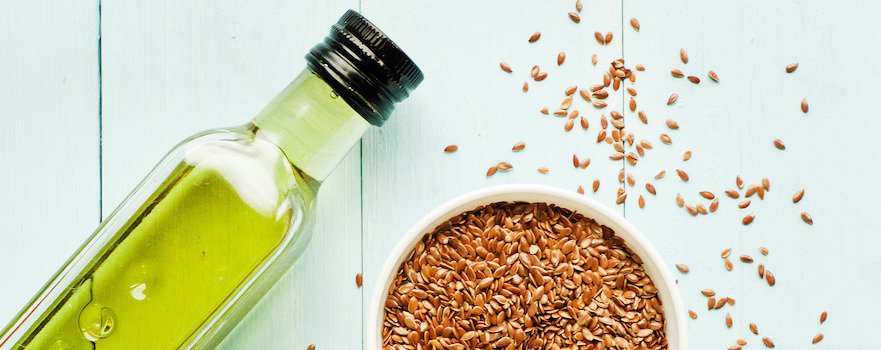
Consume sustainably: favor local, organic, and fair-trade flax seeds
✓ While flax is cultivated in many regions of the world (China, United States, India, Russia…), Canada is the main producer and exporter of flaxseed. France, for its part, produces about 50,000 tonnes of seeds each year. Production areas are mainly located in the north of the country (Normandy, Hauts-de-France…).
✓ Prefer seeds grown in France and certified organic. There are also fair-trade supply chains that support the work of small producers.
Dosage
The recommended dosage is 1 tablespoon of flaxseed per day.
Contraindications and side effects
Consumption of flaxseed has certain contraindications:
- Par mesure de précaution, on les déconseille aux femmes enceintes et allaitantes et aux jeunes enfants ;
- Les personnes souffrant de diverticulite ou d’occlusion intestinale doivent éviter d’en consommer ;
- Les gens souffrant de problèmes de thyroïde doivent en consommer avec modération ;
- Leur consommation est déconseillée en cas de troubles de la coagulation sanguine ou de stomie.
Consumption of flaxseed can cause some side effects :
- Douleurs abdominales
- Ballonnements
- Flatulences
If you experience side effects, stop taking it and consult a doctor.
Sources and scientific studies
Stéphane Fenart, Yves-Placide Assoumou Ndong, Jorge Duarte, Nathalie Rivière, Jeroen Wilmer, Olivier van Wuytswinkel, Anca Lucau, Emmanuelle Cariou, Godfrey Neutelings, Laurent Gutierrez, Brigitte Chabbert, Xavier Guillot, Reynald Tavernier, Simon Hawkins, and Brigitte Thomasset, 2010. Development and validation of a flax (Linum usitatissimum L.) gene expression oligo microarray.
Mihir Parikh, Thomas Netticadan, Grant N Pierce, 2018. Flaxseed: its bioactive components and their cardiovascular benefits.
Noureddin Soltanian, Mohsen Janghorbani, 2019. Effect of flaxseed or psyllium vs. placebo on management of constipation, weight, glycemia, and lipids: A randomized trial in constipated patients with type 2 diabetes.
Zahra Yari, Mehran Rahimlou, Hossein Poustchi, Azita Hekmatdoost, 2019. Flaxseed Supplementation Improves Anthropometric measurements, Metabolic, and Inflammatory Biomarkers in Overweight and Obese Adults.
Sonali Saxena, Charu Katare, 2014. Evaluation of flaxseed formulation as a potential therapeutic agent in mitigation of dyslipidemia.
Kailash Prasad, Arti Dhar, 2016. Flaxseed and Diabetes.
