

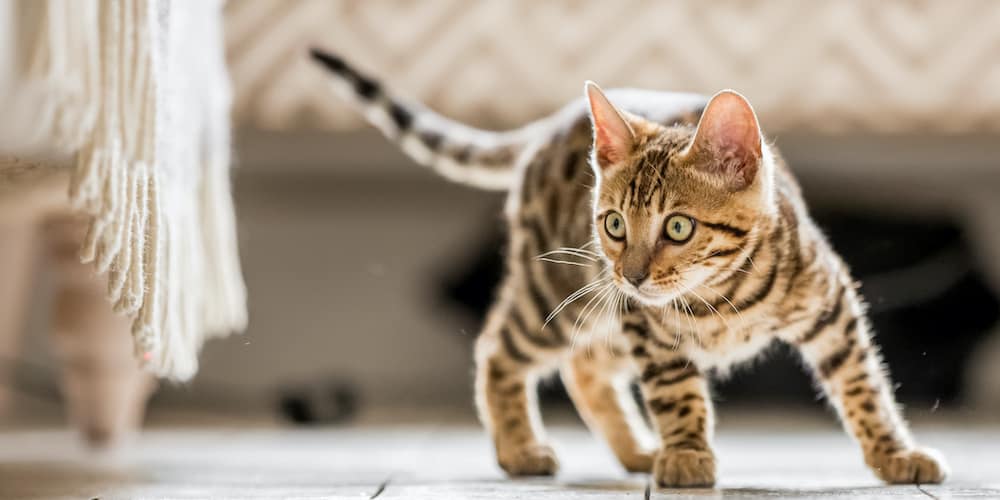
First, it’s important to clearly define the word “kitten”. Behind this term, commonly used by cat owners, are actually several stages of its life.
A kitten’s growth is not the same between birth and reaching adulthood. That’s why it’s important that your young companion’s diet meets its needs at every stage of life.
We thus distinguish the following 4 stages: birth, from birth to weaning, weaning, and from weaning to adulthood.
Your kitten’s diet therefore depends on its age but also on several factors. If you encounter any difficulty, remember that your veterinarian can help you develop a nutrition plan that best meets its needs.
📚 Read also | The best cat kibbles according to a veterinarian’s criteria
What should a newborn kitten eat?
A kitten’s needs at birth
Before birth, your kitten’s growth is already influenced by several factors. The mother’s diet, the number of kittens in the litter, and the parents’ genetics are among the factors that come into play.
It is during gestation that the kitten’s growth spurt occurs. After birth, other factors influence the nutrition of the newborn kitten, such as the course of labor or delivery, for example.
Mother’s milk
From birth, a kitten needs its mother’s milk. It’s the best nutrition for it! If, for various reasons, your kitten cannot drink maternal milk, it then becomes necessary to feed it kitten milk replacer.
If you need to bottle-feed your kitten, the number of feedings is very important during its first week of life. You should give it 7 bottle feedings per day. Then, this number gradually decreases over the following weeks.
Your veterinarian can help you calculate the exact amount of milk to give it each day by preparing a nutritional plan for your kitten.
To learn more, feel free to consult the nutritional recommendations for cats at each stage of their life.
How to feed a one-month-old kitten?
Weighing your kitten
During its first months of life, your kitten’s growth is linear. I therefore recommend weighing it regularly to monitor proper weight gain.
Keep in mind that a newborn kitten’s weight doubles after one week. It then doubles again between 2 and 4 weeks of age and again between 4 and 8 weeks of age.
The quality of the mother’s milk plays an important role during this period. Therefore, I recommend weighing your kittens on the first day of life, then at one week, and finally at two weeks of age.
Any abnormality must be reported to your veterinarian, for example if your kitten is not gaining weight or is losing weight.
Mother’s diet
The mother should have a diet suitable for nursing queens. This diet meets not only her own needs but also the nutritional needs of the kittens that nurse from her milk.
Keep in mind that your kitten’s diet must be balanced! Any imbalance can lead to health problems resulting from deficiencies, such as bone growth disorders, for example.
What to give a kitten during weaning?
When does weaning occur?
Weaning corresponds to the time when kittens begin to become independent, not only nutritionally but also behaviorally.
Weaning is a gradual process that begins at around 4 weeks of age and ends around 8 to 10 weeks of age. Your kitten thus gradually consumes solid foods.
However, if your kitten did not consume its mother’s milk and was bottle-fed, remember that weaning begins at your kitten’s 6th week of life.
Gradual transition to solid food
At weaning, your kitten therefore consumes both mother’s milk and solid food. The goal is that by the end of weaning, your kitten only eats solid food on its own.
At first, I recommend giving it a wet solid food specifically for kittens and mixing it with the milk feed. By the end of weaning, your kitten should ideally have a varied diet, meaning a mix of both wet and dry food.
A quality weaning is necessary for your kitten to smoothly transition to adult cat life.

How to feed a kitten after weaning?
Choosing the right diet
After weaning, your kitten generally continues with the solid food it progressively adopted during the weaning period.
From weaning to adulthood, a kitten’s growth depends on its diet, physical activity, and overall health.
A diet for weaned kittens is therefore essential to meet their needs. In adulthood, your feline’s growth slows, and you can then feed them adult cat food after a dietary transition.
Be careful after neutering
However, changes in diet may be necessary during this final phase. This is especially the case if you have your kitten spayed or neutered.
Indeed, such an operation is not without repercussions, because the energy requirements of a spayed/neutered kitten decrease.
After neutering, your kitten should receive fewer calories to avoid weight gain. I therefore recommend feeding them several small meals throughout the day, with food adapted to their new condition.
My advice for a neutered kitten
If your kitten seems ‘gluttonous’ after neutering, several solutions exist. Bowls are now designed to prevent your kitten from ‘gobbling’ its meals.
Additionally, you can add cooked zucchini to their portion. They help fill the stomach and are also high in moisture.
In any case, your spayed/neutered kitten’s portion should be balanced to meet its needs. Don’t hesitate to talk to your veterinarian, who can help you make this choice.
Sources and scientific studies
Gwenaël Outters, “Kitten feeding follows specific rules”, La Semaine Vétérinaire, no. 1446, 04/15/2011, pp. 42–43.
Marianne Diez et al., “Feeding the kitten during the growth period from 2 to 6 months”, Le Point Vétérinaire, Best practices in canine and feline pediatrics, 2019, pp. 24–28.
Jessica Quimby et al., “2021 AAHA/AAFP Feline Life Stage Guidelines”, Journal of Feline Medicine and Surgery, volume 23, March 2021, pp. 211–233.
