

Summary of my selection
Best Cat Kibble 2025 🥇
> Personalized kibble for every profile: kitten, neutered, senior – Caats
Best value for money
> Kibble for sterilized or indoor adult cats – Ultra Premium
Best premium cat kibble
> Kibble for neutered cats – Franklin
The importance of nutrition for health is well established. When combined with a satisfactory lifestyle, it helps ensure a long and healthy life for both humans and cats. For a long time, commercial pet foods, and in particular dry kibble, have been favored by pet owners.
Convenient, complete, safe (notably thanks to their cooking and low moisture content), anti-tartar, cat kibble truly has many advantages. Added to that is their crunchiness that many animals adore.
But in recent years, brands have multiplied, touting their virtues with bold images of chicken fillets or fresh peas printed on flashy packaging. Yes, 15 million cats in France — no wonder they attract so much attention…
So, it’s hard for the average person to make the right choice. Because marketing is fine, but for Réglisse or Plume, a good RPP (Protein-to-Phosphorus Ratio — more on that later in the article) is better!
Brands tested and compared: Advance (Affinity), Brekkies (Affinity), Caats, Edgar Cooper, Eukanuba (Spectrumbrands), Franklin, Hill’s, Iams (Spectrumbrands), Lifelong (Amazon), Nature’s Variety (Affinity), Orijen (Mars), Purina One (Nestlé), Purina Pro Plan (Nestlé), Ultra Premium, Virbac, Wellness Core, Whiskas (Mars), Ziggy.
We evaluate all products independently. If you click on one of the links provided, a commission may be paid to us, without affecting the price or the ranking.
A small feline, very carnivorous…
The cat has specific nutritional needs. First, it is a strict carnivore, unlike the dog, which is more omnivorous. This does not mean it only eats meat, but that proteins (especially proteins of animal origin, i.e., from meat, fish, or eggs) should play a predominant role in its diet.
The cat also has particular requirements for certain amino acids (the components of proteins) such as taurine, which is absent from plant proteins. In addition, the cat has vulnerabilities: its kidneys and urinary system, which need to be preserved.
… and prone to being overweight
In France, the vast majority of male cats are castrated and females are spayed (ovariectomized). However, this sterilization is not without consequences for the body’s metabolism: appetite increases and fat accumulates. Our sterilized cats are prone to becoming overweight.
If not addressed and if the animal is sedentary, this can lead to obesity. As in humans, excess weight increases the risk of many conditions such as diabetes, osteoarthritis, and hepatic lipidosis… It is estimated that the energy needs of a sterilized cat are reduced by about 20% compared to an intact animal. This should be taken into account when formulating dry foods intended for this feline population.
How to find the right kibble? The one that best meets the needs of a sterilized cat? To navigate the jungle of the pet food market, with Darwin Nutrition I present this comparison of a sample of 19 brands. This article will also give you pointers to spot the best kibbles by decoding the labels.
Best kibble: our review
With Darwin Nutrition we produced a ranking of the 19 kibbles studied. Here are the results, overall and according to a few specific criteria.
This ranking is based on objective criteria, using current knowledge of feline nutrition, but it only applies to the kibbles selected for this comparison. Other foods not studied here are certainly excellent products as well.
Note: Prices are provided as a guideline; they may vary from site to site and depending on promotions.
# Best Cat Kibble 2025 🥇
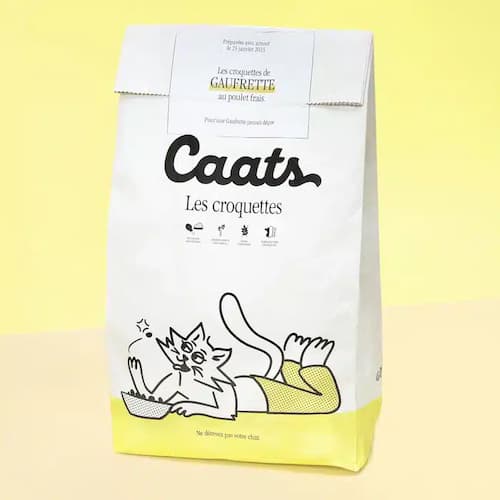
Caats – Personalized kibble
Rating: 4.5/5
Nutrition: ★★★★★
Safety: ★★★★☆
Brand: ★★★★★
Advantages
- Protein percentage and source, RPP and RPC are top-notch
- Customizable almost endlessly
- Made in Vendée
- Ability to view the kibble composition before ordering
Disadvantages
- A slightly high fat content (15%)
- The price of a premium kibble (discount from 2 cats)
Launched by veterinarian Jean-Marc Denoun, Caats is a small brand that is expanding by tapping into the trend for tailor-made products.
To evaluate Caats, I created a profile for “Riton”, a 6-year-old neutered male cat; I then filled out a questionnaire about his age, breed, body condition, physical activity (none!), and his health issues (osteoarthritis, kidney disease, urinary stones, digestive problems, allergies…).
I immediately had access to the specifications of the kibble recommended for Riton, and it was all good (41% protein, 21.5% carbohydrates, 8% ash, and 4.5% fiber). One more click and you get his trial kit.
Subscription option so you don’t have to think about it anymore — a real bonus for an overbooked human. Note: if your companion has a chronic illness, their personalized kibble does not replace a veterinary consultation.
A responsive brand. Sometimes a bit too much. If you’re allergic to pushy marketing, look elsewhere. Founded in 2020, Caats already has 79,000 followers and receives a ‘good’ rating online.
Price: €29.70 for a 3-kg bag
# Best value for money
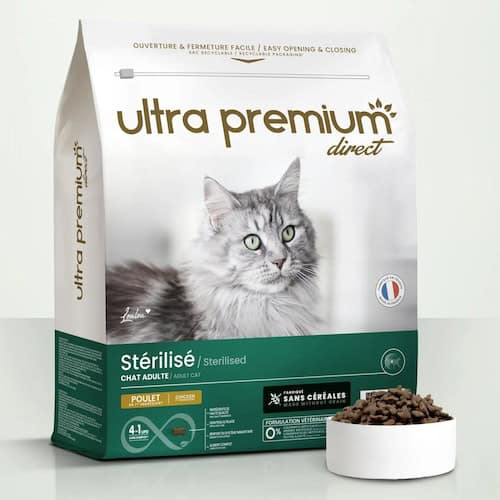
Ultra premium direct – Grain-Free Kibble for Adult Neutered or Indoor Cats
Rating: 4.4/5
Nutrition: ★★★★☆
Safety: ★★★★☆
Brand: ★★★★★
Advantages
- Protein OK
- Highest-rated brand
- No middleman to reduce costs
- Made in Lot-et-Garonne
Disadvantages
- A slightly low fiber content for a light kibble (2%)
- Non-veterinary brand
The brand’s 183,000 followers won’t speak ill of it, since they gave it a rating of 4.7/5!
With a more than decent composition, this kibble offers the best value-for-money in our panel (€9.60 per kilogram when ordering on the brand’s website, €8.66 with a subscription in 2024). An interesting compromise for tight budgets in these inflationary times.
Ultra Premium Direct kibble contains 43% protein, 23% carbohydrates, and 15% fat. They are produced in France from ingredients sourced in the European Union. The brand is a member of FACCO, which guarantees compliance with animal feed regulations.
And for those averse to ordering online, Ultra Premium has also opened stores in several French cities; the latest just opened in Normandy (Hérouville).
Price: €28.90 for a 3 kg bag
# Best premium cat kibble
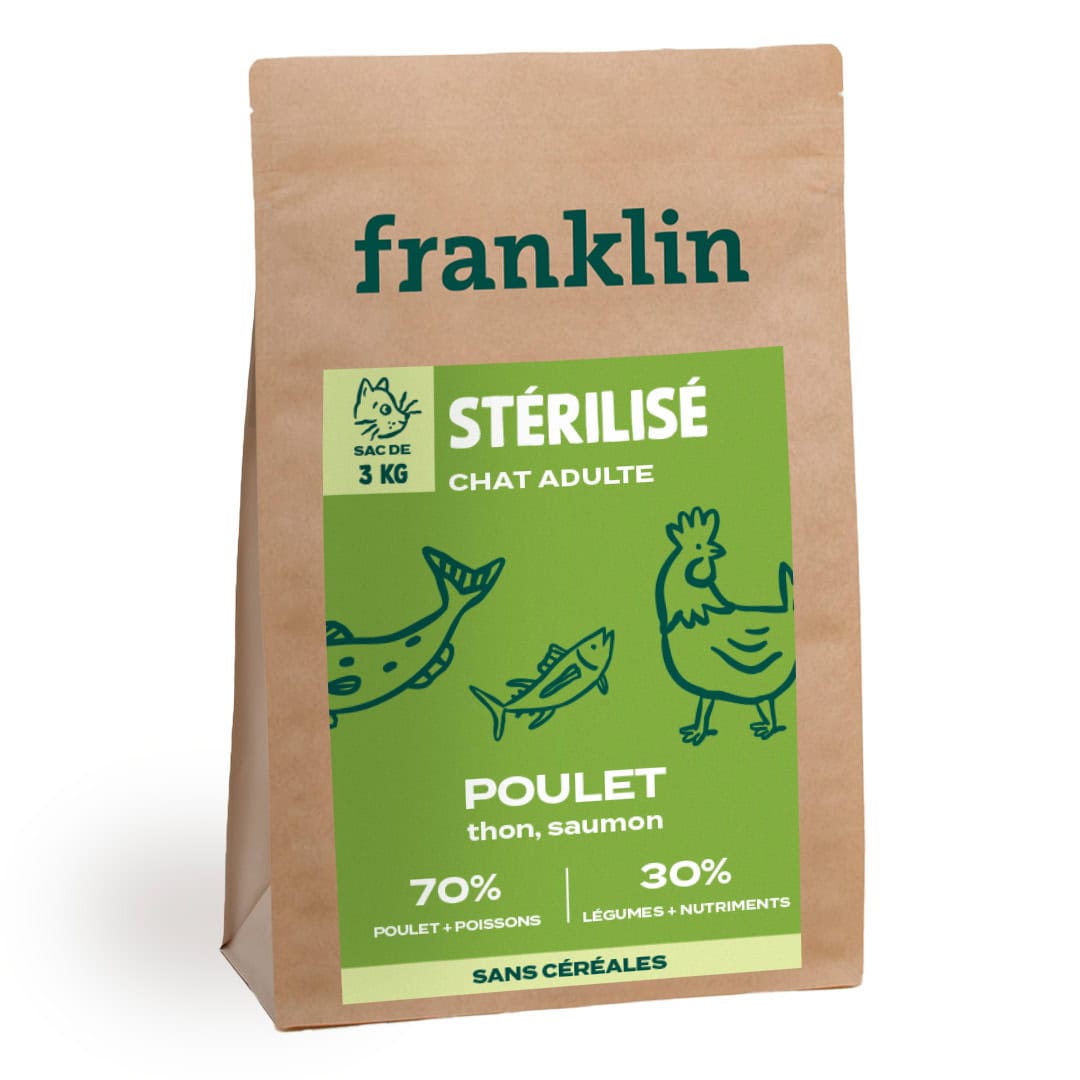
Franklin – Grain-free cat kibble
Rating: 4.4/5
Nutrition: ★★★★☆
Safety: ★★★★☆
Brand: ★★★★★
🎁 Promo code -30% + free shipping: DARWIN30
Advantages
- Good nutritional score
- Excellent value for money
- Low calorie
- A French brand
Disadvantages
- Not the highest RPP in the comparison
- Manufactured in the EU, not France
Franklin is a small up-and-coming brand (22,000 followers already!). Founded only in 2018 by two lovers of cats and dogs, the company is based in Paris. They are among the pioneers of single-protein kibble for the most sensitive cats. It offers very good value for money with quality products at a reasonable price.
The kibbles we selected are based on chicken and salmon proteins (70% of the ingredients). They are among the lowest in fat in our selection, with a fat content of 11% and 355 kcal/100 g. They also contain omega-3 fatty acids for the heart and skin, as well as vitamins and minerals.
Franklin’s kibble is manufactured in the Czech Republic. The brand is rated 4.7/5 on Trustpilot, which shows real customer satisfaction. Customer service is also very responsive (email reply within half a day!).
Price: €31.90 for a 3 kg bag
# Best veterinary-brand kibble for spayed/neutered cats
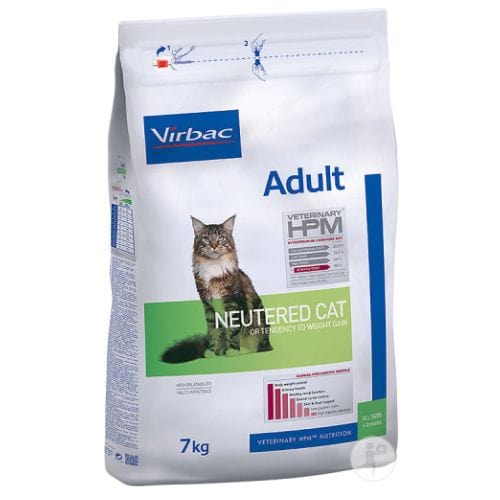
Virbac HPM – Kibble for sterilized adult cats
Rating: 4.5/5
Nutrition: ★★★★★
Safety: ★★★★★
Brand: ★★★★☆
Advantages
- 44% protein, 90% of animal origin (pork and poultry)
- A recognized French veterinary brand
- Results on feline health supported by scientific studies, with 36 publications to support them
- High in fiber
Disadvantages
- Packaging in English and not very appealing
- The price of the (very) high-end kibble
Cocorico! It’s yet another French kibble (made in the Camargue) that stands out! The HPM range (for Hyper-Premium) is developed by veterinary nutritionists and comes with all the guarantees of a veterinary brand. The Virbac Group, founded in 1968 by Pierre-Richard Dick, is a major player in animal health with lines of medicines, hygiene products, and pet foods.
Well-balanced kibble, low in carbohydrates (20.5%) and high in fiber (8%) for better digestive comfort and improved satiety; a significant fiber content that should not come at the expense of stool quality (possible in some sensitive animals).
Virbac HPM kibble suffers from a slight lack of visibility (5,282 followers); it can be found in veterinary clinics or on the websites of those clinics and pet stores. A technical kibble to discover, offering veterinary quality and safety with the same standards as human food. Buy it with your eyes closed!
Price: €35.95 for a 1.5 kg bag
# Best kibble for overweight cats
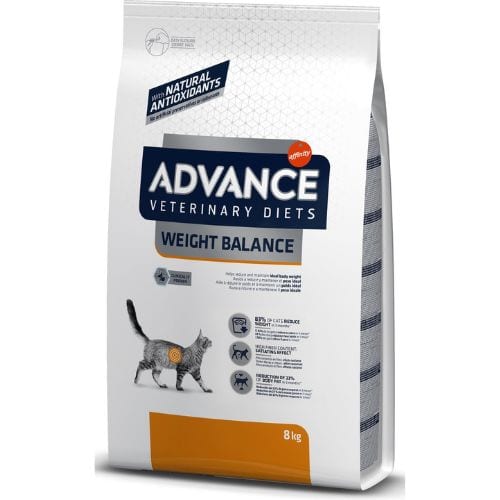
Advance – Veterinary diets, Weight balance
Rating: 4.1/5
Nutrition: ★★★★☆
Safety: ★★★★★
Brand: ★★★☆☆
Advantages
- The lowest-calorie in the panel
- Clinically tested for weight reduction
- High fiber levels
- A good protein profile
Disadvantages
- Corn as the main ingredient
- A somewhat messy brand website
With a good protein content (43%) and controlled fat (9%) and carbohydrate (26%) levels, the lightest kibble in the panel (329 kcal per 100 g) is Spanish.
Advance Veterinary Diets is indeed the veterinary range of the Spanish brand Affinity, which challenges the giants Nestlé and Mars. The Weight Balance kibble promises to help overweight animals lose weight (provided the recommended amounts are followed). They also help maintain a healthy weight.
One downside: we regret that corn is the primary ingredient in this reduced-fat formula, just ahead of poultry.
Advance products are made in Spain and available online and in garden centers (they are not all ‘veterinary diets’). Regarding safety, the brand is affiliated with FACCO.
Price: €32.99 for the 3-kg bag.
Methodology
Darwin Nutrition selected 19 kibbles for neutered cats among the best-selling online. This is of course not an exhaustive list, but a representative sample of the dry foods most consumed by our feline friends. Each was given an overall score including: a nutritional score, a food safety score, a brand score. I personally handled the first two. Darwin Nutrition handled the brand score based on reputation, transparency, and customer satisfaction via online reviews.
The information was collected from the manufacturer’s website. When it was not available, an email was sent to customer service. If that email went unanswered, one or more phone calls were made.
Unfortunately, some brands did not play the transparency game, failing to provide important information regarding the quality of their sterilized cat kibble, such as phosphorus content, for example. They were, of course, penalized in their rating.
→ Access my full comparison table here (Google Sheet)
1. Nutrition quality score
Since the cat is a strict carnivore, I paid particular attention to the amount and quality of proteins. Next came the mineral levels, which must be controlled to avoid urinary stones and kidney problems. For sterilized cat kibble, I also looked for moderate carbohydrate and fat levels to prevent weight gain, and a satisfactory fiber content for the satiating effect.
However, it should be kept in mind that the sum of all nutrients must equal 100% ; that is, if one component is drastically reduced, such as fat, the others statistically increase, such as the carbohydrate level. The composition of sterilized cat kibble is therefore also a matter of compromise.
Proteins
For proteins, I gave a score out of 5. It took into account the main ingredient, which had to be animal protein (fish or meat) ; it is still unfortunate for a small carnivorous feline to find products whose first ingredient is a cereal.
I then looked at the total percentage of protein, which should be greater than 35%. However, this percentage is not sufficient because it does not indicate the quality of the protein, nor the actual amount ingested by the animal. For this I used two tools:
The RPP or Protein-to-Phosphorus Ratio : it is the ratio of protein to phosphorus in the kibble. It indicates protein quality, and specifically an excessive presence of bone and cartilage. An RPP >35 is sought.
The RPC or Protein-to-Calorie Ratio : it is calculated by dividing the protein percentage by the food’s energy density. The RPC provides an estimate of the amount of protein ingested, which also depends on the amount of kibble actually eaten, and therefore on the food’s energy density. For a neutered cat, the RPC should be greater than 87, or even 105 if it is also sedentary (indoor cat).
And this is where the problem lies, because phosphorus and energy levels (not required on labels) have not always been easy to obtain… Some major brands (see table) among the best-selling have obstructed the disclosure of this vital information necessary to judge the quality of cat kibble, which is neither fair to the customer nor reassuring for cats…
Minerals or crude ash
For a long time, kibble had a bad reputation, accused of promoting the onset of urinary problems in cats. This was due to high and unbalanced mineral levels. It seems the lesson has been learned, as none of the products exceeded 10% crude ash.
In detail, I paid particular attention to the phosphorus level when it was available. Phosphorus is indeed singled out for harmful effects on cats’ kidney health. Its level should not exceed 1.1%. The minimum level is around 0.7%, and 1% for calcium. The Calcium/Phosphorus ratio must be greater than 1.
Fats, carbohydrates, and energy
These nutrients provide energy. In excess, they promote hyperglycemia (sugars) and weight gain. For kibble for spayed/neutered cats, a fat content of 9 to 12% and a carbohydrate content not exceeding 25 to 30% are generally recommended.
I did not favor ‘no grain’ or grain-free options, which are more of a fad than a real nutritional issue. Overall, cats digest starch well (necessary for kibble texturization and energy supply). In grain-free kibbles, corn, rice, or wheat are replaced by legumes (peas) that also provide starch and are not more digestible. Peas are even suspected, according to studies, of being cardiotoxic in dogs. There is currently no data pointing in that direction for felines.
Fibers (or crude cellulose), for their part, are important for intestinal transit and also help calm the feeling of hunger. A final important point for animals prone to weight gain and that often require restricted portions. However, in excessive amounts, fibers can cause digestive irritation. The recommended content is between 1 and 5%, up to 8-9% for kibble for spayed/neutered cats.
Energy in kcal reflects the caloric intake per 100 g of kibble; it should be adjusted for sterilized cats that are often prone to becoming overweight.
The nutritional analysis made it possible to assign a score out of 10 to each product.
2. Food safety score
This criterion was rated out of 5. It took into account the place of production (Europe is better, France even better, for food safety and for the planet).
I also looked at the pet food manufacturer’s membership in FACCO. These members commit to complying with the regulations in force in the European Union.
None of the kibbles was organic. An unfortunate fact, probably linked to the cost of organic raw materials.
Finally, the score was increased for veterinary sterilized cat foods. These products are the only ones that guarantee regular quality controls and provide clinical studies demonstrating the beneficial effects of their food on feline health.
3. Brand score
Darwin Nutrition handled this section, taking into account brand recognition (number of followers) and the brand’s longevity.
Customer satisfaction (here the owner), as reflected by online reviews (if available), is a good indicator of the food’s palatability. However, for sterilized cat kibble, excessive palatability can lead to overconsumption, resulting in weight gain or even obesity. While flavor is important, the food does not necessarily need to be “too tasty” (and often too fatty, since fats are largely what make food appetizing).
The transparency of the cat food brand (comprehensive website, promptness in responses…) was also taken into account.
The sum of these three scores made it possible to obtain an overall score out of 20, converted to an overall score out of 5.
Full comparison
| (note sur 5) | Note globale | Note Nutrition | Note Sécurité | Note Marque | |
|---|---|---|---|---|---|
| #1 | Caats 🥇 | 4.5 | 5 | 4 | 5 |
| #2 | Ziggy | 4.5 | 5 | 4 | 5 |
| #3 | Virbac | 4.5 | 5 | 5 | 4 |
| #4 | Franklin | 4.4 | 4 | 4 | 5 |
| #5 | Ultra Premium | 4.4 | 4 | 4 | 5 |
| #6 | Hill’s | 4.2 | 5 | 5 | 3 |
| #7 | Advance | 4.1 | 4 | 5 | 3 |
| #8 | Edgar Cooper | 3.9 | 3 | 4 | 5 |
| #9 | Orijen | 3.8 | 4 | 3 | 4 |
| #10 | Purina Pro Plan | 3.6 | 5 | 3 | 3 |
| #11 | Hill’s | 3.6 | 3 | 5 | 3 |
| #12 | Iams | 3.0 | 2 | 4 | 3 |
| #13 | Eukanuba | 2.9 | 2 | 4 | 3 |
| #14 | Whiskas | 2.0 | 2 | 3 | 1 |
| #15 | Nature’s Variety | 1.9 | 2 | 2 | 2 |
| #16 | Purina One | 1.9 | 2 | 2 | 2 |
| #17 | Wellness Core | 1.7 | 2 | 1 | 2 |
| #18 | Lifelong | 1.5 | 2 | 2 | 1 |
| #19 | Brekkies | 1.3 | 1 | 1 | 2 |
→ Access my full comparison table here (Google Sheet)
Frequently Asked Questions (FAQ)
How much kibble should I give my cat per day?
The exact amount of food to provide depends on different factors: the cat’s age, reproductive status, breed, activity level, body condition, and also the product’s energy density… Unless you’re a nutritionist comfortable with the equations, it’s hard to figure out. The best option is still to trust the brand; it usually indicates the amount of kibble to feed based on the cat’s weight. This can be a specific amount for customized kibble or a range. In that case, I recommend aiming for the average dose for a cat of normal weight, and the minimum amount for an overweight cat.
Be careful though, a cat on a diet can become very… grumpy. To stave off hunger, it’s recommended to give several small meals a day. You should also choose a light kibble, possibly mixed with wet food (because it’s full of water, it fills the stomach better).
Why does my cat vomit up its kibble?
The regurgitation of kibble within minutes after a meal (preferably on the bed or the rug!) is a classic feline behavior! It can simply be a sign of a too-greedy cat. To remedy the problem, it is recommended to divide the amount of kibble over the day. There are very practical kibble dispensers for this. Mild gastritis (stomach irritation from hair or catnip, for example) can also cause vomiting of undigested food from the bowl. Food intolerances can also be involved.
If the problem persists or is accompanied by diarrhea, weight loss, or a decline in general condition, you should of course consult a veterinarian.
What should I give my cat when I run out of kibble?
Ah… The best thing is to plan ahead so you don’t run out of your pet’s usual food. Indeed, sudden dietary changes can cause digestive issues (diarrhea). That said, we are not going to let a cat starve. While you wait to refill your usual kibble, you can get supplies at a veterinary clinic (the best option) or at a supermarket or convenience store. The products found there are of lower quality, but can suffice for a few days. Also, this small carnivore can eat chicken, ground beef, or tuna… mixed with a spoonful of well-cooked rice, a few slices of carrots, or green beans.
Why has my cat stopped eating its kibble?
Various reasons can lead to a dislike of the usual kibble:
· An anorexia (loss of appetite) related to illness
· Dental problems
· A spoiled bag (rare, but it can happen) or one that has been opened for too long
· A very picky cat (it does that to you regularly)
If in addition to neglecting its kibble, your cat seems listless or shows worrisome symptoms, don’t hesitate to consult a veterinarian.
To avoid altering their flavor and quality, it is recommended to store the kibble in a cool, dry place. You should also reseal the bag well with a clothespin or the zipper provided for this purpose. Transferring the kibble into a metal or plastic container can also give it a taste the cat may not appreciate.
Should you buy grain-free kibble?
Yes, and no…
“No grain”, “grain-free”, this new concept that is all the rage in the pet food world — is it really justified? If it’s true that “in the wild” a cat doesn’t eat corn, wheat or rice, it doesn’t ingest more potatoes, peas or lentils either, these ingredients that replace grains in kibble by providing their starch.
You don’t need to throw your grain-containing kibble in the trash, especially if it seems to have suited your companion for many years. However, the “no grain” products that have sprung up on the market seem to be an acceptable alternative.
Always keep in mind that every cat is unique. Except for deal-breaking nutritional issues (or a blatant lack of transparency from the brand), the right food for your furry companion is the one they like, that doesn’t make them gain weight and… gives them healthy stools (a sign of good nutrient absorption).
Should you give your cat kibble or wet food?
Nowadays, the trend is to mix dry and wet food for cats for various reasons:
· A kibble-only diet can, for some felines, cause a hydration deficit that leads to the formation of urinary crystals or stones. Indeed, some animals don’t drink enough to compensate for the low moisture content of kibble. Water fountains can be a good way to encourage these cats to drink. Offering wet pâtés, chunks, or mousse rich in water (about 75% vs. 10% for kibble) is also a solution.
· Thanks to its high water content, wet food can also be beneficial in cases of chronic constipation.
· Lower in calories and more satiating, it helps prevent overweight and obesity.
It is therefore possible to give wet food once or twice a day and supplement with kibble that the cat can nibble on throughout the day.
When should you switch to kibble for a sterilized cat?
In France, animals are generally sterilized at around 6 months of age. This procedure has many beneficial effects (reduced mammary tumors in female cats, fewer fights and a lower risk of contracting FIV in male cats…). However, it can, when combined with a certain degree of inactivity, lead to excessive weight gain. Since prevention is better than cure, it is recommended to start feeding kibble formulated for sterilized cats immediately after neutering or spaying. Some brands offer kibble for sterilized kittens; these can be useful for cats with a longer growth period, such as the Maine Coon.
When changing foods, you should undertake a dietary transition between kitten food and sterilized cat food. Simply gradually incorporate the new kibble into the diet.
And for a long, healthy life, just like us humans, avoid junk food and favor the best kibble for sterilized cats.
Bibliography
1. https://europeanpetfood.org/self-regulation/nutritional-guidelines/
2. https://pubmed.ncbi.nlm.nih.gov/29623690/
3. https://onlinelibrary.wiley.com/doi/full/10.1111/jvim.15961
5. http://www.facmv.ulg.ac.be/amv/articles/2001_145_4_03.pdf
5. Blog of Dr. Géraldine Blanchard, veterinary nutritionist
6. Blog of Dr. Charlotte Devaux, veterinary nutritionist
7. Website of FACCO, the Federation of Manufacturers of Dog, Cat, Bird and Other Pet Food
