



Our selection
# Best magnesium 🥇
> Magnesium – Nutri&Co
# Best alternative
> Magnesium bisglycinate – Novoma
# Best marine magnesium
> Marine magnesium – Nutrimea
Magnesium is the 4th most abundant mineral in the human body. Essential for the proper functioning of the body, it is involved in more than 300 biological reactions1, such as muscle contraction, nerve function… and contributes to energy production.
Its importance is crucial for certain organs. Thus, 85% of magnesium is distributed in the bones and muscles: 60% stored in the bones, where it plays a full role in their metabolism (it’s not just calcium!), and 25% in the muscles to enable normal muscle function. The cardiovascular system also has a vital need for this mineral.
Medical literature increasingly shows that adequate magnesium intake could help prevent health problems and chronic diseases.
Thus, studies have shown that magnesium supplementation may be beneficial for lowering blood pressure2, improving certain sleep disorders3, as well as mood and migraines (for these last 2, the level of evidence still needs to be strengthened). A good amount of magnesium could help reduce certain risk factors for heart disease4 and could have an effect on insulin sensitivity and blood sugar control5. But these effects have not yet led to authorized claims at the European level.
Even though diet is a good source, changes in eating habits over the past few decades have had a negative effect on nutrient intake. The rise of ultra-processed foods and the decline in consumption of foods rich in magnesium have led to a marked decrease in intake.
As a result, numerous studies around the world show a significant percentage of the population is deficient in magnesium. In France, 23% of women and 18% of men have insufficient intake6.
Magnesium deficiency sometimes goes unnoticed, or else it shows up through nonspecific signs such as fatigue, low energy, sleep difficulties… Others, such as eyelid twitching, are more suggestive of magnesium deficiency.
If you notice signs suggestive of a deficiency, the recommended approach is to consult a healthcare professional to discuss the issue and assess your situation. Supplementation may help improve the symptoms.
Conversely, there is no point in taking magnesium supplements if you do not need them. Even though it is considered relatively safe, be aware that taking too much can cause unwanted side effects. The most common are a laxative effect and digestive discomfort.
Also, people who are already taking diuretic or heart medication, and people with kidney failure, should be especially careful: medical advice is essential.
Brands evaluated : Belle&Bio, Forté Pharma, Granions, Juvamine, Mag 2, Natural Elements, Novoma, Nutri&Co, Nutrimea, Nutripure.
Best magnesium: our opinion
# Best magnesium 🥇
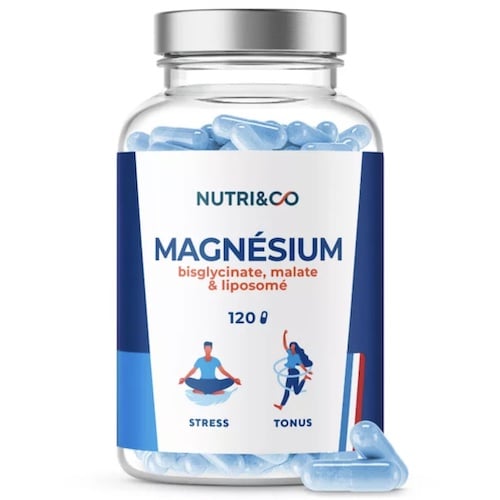
Nutri&Co – Magnesium
Rating: 4.7/5
Nutrition: ★★★★★
Safety: ★★★★☆
Brand: ★★★★★
Pros
- Patented MagShape® complex
- 3 forms of magnesium
- Lots of information
- Good value for money
Cons
- No taurine
The Nutri&Co brand was created in 2017 and is headquartered in the south of France. It offers a wide range of dietary supplements. Nutri&Co has built a strong community on Instagram.
Their Magnesium product, made in France, is positioned around energy support, stress reduction, and muscle function.
Nutri&Co highlights a formula made up of 3 forms of magnesium (oxide, bisglycinate, and malate), one of which has the distinction of being patented.
Indeed, liposomal magnesium Magshape® achieves the feat of delivering both the high concentration of magnesium contained in magnesium oxide and good absorption thanks to a specific coating.
3 capsules contain 300 mg in total, with the recommended dosage being one capsule with each meal.
To enhance absorption, the presence of vitamin B6 completes the formula (2 mg per daily dose, or 143% of the NRV).
Several additives are listed among the ingredients. However, these are natural substances such as a spirulina and apple concentrate, corn starch, and sunflower lecithin.
As with all of its products, Nutri&Co emphasizes a scientific approach in the development of its dietary supplements.
Access to the analyses adds a transparent and reassuring aspect.
The 120-capsule bottle provides a 40-day supply for an affordable cost of €19.90.
# Best alternative
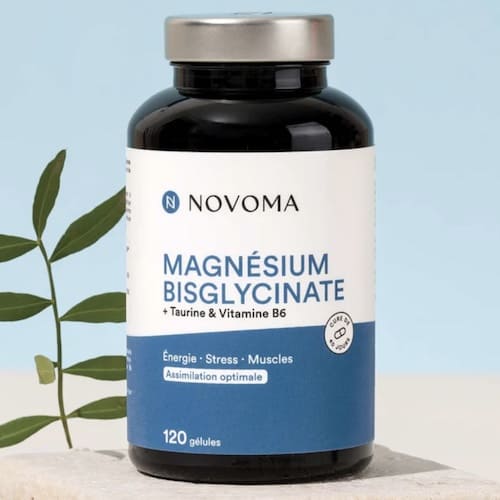
Novoma – Magnesium
Rating: 4.0/5
Nutrition: ★★★★☆
Safety: ★★★★☆
Brand: ★★★★☆
Pros
- Presence of vitamin B6 and taurine
- Brand transparency
- Only one additive (natural)
- Good value for money
Cons
- Only one form of magnesium
Novoma is a French brand founded in 2012. It claims the natural and traceable origin of all its ingredients and made in France.
The main indication displayed for their Magnesium Bisglycinate concerns athletes and people with insufficient intake, which can manifest as fatigue or muscle discomfort.
The product is made with a single form of magnesium for a daily intake of 300 mg.
The recommended dosage is 3 capsules per day in one dose (noon or evening). They also contain vitamin B6 (2.8 mg, or 200% of the NRV), plus 120 mg of taurine. These two elements are complementary and have recognized properties that help promote magnesium absorption.
In terms of additives, the only one noted is corn starch, which is little compared with what can be read on the label of some products in the selection.
Novoma explains the choice of bisglycinate in detail.
A bottle of 120 capsules (40-day supply) costs €20.90.
# Best marine magnesium
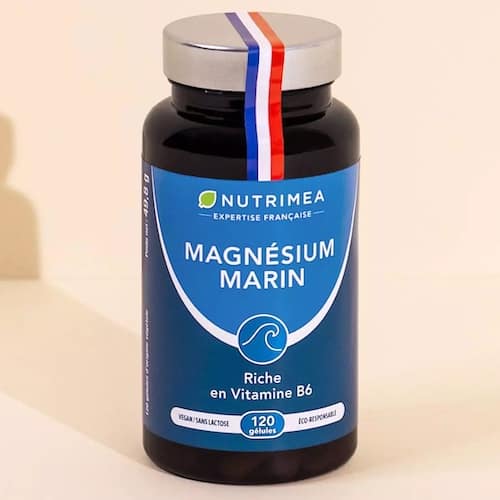
Nutrimea – Magnesium
Rating: 3.7/5
Nutrition: ★★☆☆☆
Safety: ★★★★★
Brand: ★★★★☆
Pros
- Affordable
- No additives
- Strong brand recognition
Cons
- Low magnesium dosage
- Only one form of magnesium
Nutrimea is a French laboratory that has been in business for more than 10 years. The brand benefits from a high rating on verified review sites (9.3/10 based on a little over 550 reviews).
Their marine magnesium supplement contains only one form of magnesium: magnesium oxide.
The magnesium content is the lowest in the selection at the recommended dose by Nutrimea: 150 mg in 1 capsule. In some cases, a dose of 2 capsules is indicated for people with severe deficiencies, which implies knowing what it means to be very deficient…
It contains vitamin B6 at 0.82 mg (58% of the NRV). A big advantage is that there are no additives and the product is made in France.
In addition, the value for money is excellent.
The high ranking in the selection of the best marine magnesium comes from the fact that the safety scores (additives and place of manufacture) and brand recognition are very good. But the nutritional score alone is not excellent (the overall ranking is obtained by averaging).
Full comparison
| Note globale | Nutrition | Sécurité | Marque | |
|---|---|---|---|---|
| #1 – Nutri&Co 🥇 | 4,7 | 5 | 4 | 5 |
| #2 – Novoma | 4,0 | 4 | 4 | 4 |
| #3 – Nutrimea | 3,7 | 2 | 5 | 4 |
| Nutripure | 3,7 | 3 | 4 | 4 |
| Natural Elements | 3,3 | 3 | 4 | 3 |
| Belle&Bio | 3,3 | 3 | 4 | 3 |
| Granions | 3,3 | 4 | 3 | 3 |
| Forté Pharma | 3,0 | 4 | 2 | 3 |
| Juvamine | 2,7 | 3 | 3 | 2 |
| Mag 2 | 2,3 | 3 | 2 | 2 |
→ Access our full comparison table here (Google Sheet)
Methodology
The product rankings are established by our editorial team, based on objective criteria (nutritional value, safety, and brand). The methodology and FAQ were prepared by Géraldine Dubois, a physician specialized in nutrition, who serves as a scientific expert. Product data were collected in May 2024 from the brands’ websites. Prices and characteristics may change.
For this comparison of magnesium, the supplements most frequently purchased online were selected. Each product was analyzed according to 3 main criteria: nutrition, safety, and brand.
Based on the scores awarded, a ranking was established to choose the best magnesium, the best alternative, and also the best marine magnesium.
1. Nutritional value
The different forms of magnesium and their content
For magnesium to be absorbed, it needs to be accompanied by a carrier, in other words another molecule to which it will be attached to facilitate passage through the intestinal barrier. The quality of absorption is essential.
There are several forms of magnesium that differ from one another by 3 important characteristics: the amount of elemental magnesium (that is, the percentage of magnesium contained in the product), its bioavailability (in other words, its ability to be used effectively), and digestive tolerance.
Unfortunately, it is difficult to combine these 3 qualities in a single product.
Dietary supplements come in the form of magnesium salts, of organic and inorganic origin.
The so-called inorganic forms, such as magnesium oxide or carbonate, have a higher magnesium content, but are less well absorbed and generally less well tolerated digestively7.
For organic forms, such as magnesium citrate or magnesium malate, it’s the opposite: lower content but better absorption8 and better tolerance.
A new generation of formula aims to combine the 2 main desired qualities (content and absorption). The principle: encapsulate a magnesium with high content and increase its absorption thanks to a coating that will promote crossing of the intestinal barrier.
Some forms of magnesium are expected to act particularly on certain symptoms. However, the scientific literature needs to grow to confirm these hypotheses.
Brands sometimes combine several forms of magnesium in their formula to offset the drawbacks of each one and enhance the effects.
Other interesting active ingredients
2 substances are known to promote the absorption of magnesium by the body:
- vitamin B6, which facilitates the absorption and uptake of magnesium by the tissues9.
- taurine, which promotes an increase in magnesium levels in cells10.
2. Safety
Additives
Capsule or tablet presentation formats may contain additives.
Reviewing the label is important and should be clearly highlighted in the selection. Some products do not contain additives, while the list is longer for other brands.
Origin
There is no synthetic magnesium, just as there can be no organic magnesium, regardless of its origin.
However, a natural origin does not necessarily mean purity and a raw product.
Even when magnesium is extracted from seawater (marine), extraction processes are necessary and differ depending on the form of magnesium.
Analyses make it possible to get an idea of the degree of purity to ensure there are no residues, including heavy metals, in the finished product.
French origin, renowned for its demanding specifications, is preferable in terms of safety and traceability.
3. Brand
I recommended taking into account the brand’s authority in the market, through its longevity, customer reviews verified by an independent company, and its popularity.
In general, it is reasonable to appreciate that the brand is transparent about the reasons for choosing the form of magnesium, especially when it relies on scientific data.
It is also important to have access to certificates on extraction methods and to communicate analyses regarding the presence of any residues and heavy metals. In my opinion, this is an important guarantee of transparency.
Frequently Asked Questions (FAQ)
Where can magnesium be found?
Food is full of sources of magnesium. It should be prioritized.
Among the most concentrated sources, there are seaweeds (sea lettuce, kombu), dried herbs (parsley, basil, mint…), cocoa, seafood, whole grains, legumes, nuts (almonds, cashews…), coffee, and even certain mineral waters.
However, changes in eating habits and the growing mineral poverty of soils are responsible for deficiencies.
When should magnesium be taken: in the morning or at night?
The body of studies on magnesium supplementation does not clearly determine the best time of day to take magnesium.
Instead, it is rather the regularity of taking it over several weeks to several months that seems to be most important for achieving the best effectiveness of supplementation.
How much magnesium should be consumed per day?
The recommended dietary intake (RDI) advocated by ANSES11 is 380 mg/day for a healthy adult man and 300 mg/day for a woman.
EFSA (the European Food Safety Authority) defines an adequate intake of 350 mg/day for men and still 300 mg/day for women12.
What are the symptoms of a magnesium deficiency?
The signs of magnesium deficiency are not always specific: fatigue, irritability, nervousness, sleep disorders, emotional hypersensitivity…
But some symptoms are more likely to point to it: eyelid twitching, cramps, muscle weakness, tingling in the arms or legs.
What is the best type of magnesium?
The best type of magnesium is mainly the one that combines the 3 desired qualities: a high content of elemental magnesium, a high absorption capacity, and good digestive tolerance.
Other criteria also come into play: as few additives as possible and a combination with vitamin B6 and taurine.
Bibliography
1. Martyka Z, Kotela I, Blady-Kotela A. Clinical use of magnesium. Przegl Lek. 1996;53(3):155-158.
2. Dibaba DT, Xun P, Song Y, Rosanoff A, Shechter M, He K. The effect of magnesium supplementation on blood pressure in individuals with insulin resistance, prediabetes, or noncommunicable chronic diseases: a meta-analysis of randomized controlled trials. Am J Clin Nutr. 2017;106(3):921-929.
3. Zhang Y, Chen C, Lu L, et al. Association of magnesium Intake With Sleep Duration and Sleep Quality: Findings From the CARDIA Study. Curr Dev Nutr. 2021;5(Suppl 2):1109.
4. Tangvoraphonkchai K, Davenport A. Magnesium and Cardiovascular Disease. Adv Chronic Kidney Dis. 2018;25(3):251-260.
5. Simental-Mendía LE, Sahebkar A, Rodríguez-Morán M, Guerrero-Romero F. A systematic review and meta-analysis of randomized controlled trials on the effects of magnesium supplementation on insulin sensitivity and glucose control. Pharmacol Res. 2016;111:272-282.
6. DiNicolantonio JJ, O’Keefe JH, Wilson W. Subclinical magnesium deficiency: a principal driver of cardiovascular disease and a public health crisis. Open Heart. 2018;5(1):e000668.
7. Blancquaert L, Vervaet C, Derave W. Predicting and Testing Bioavailability of Magnesium Supplements. Nutrients. 2019;11(7):1663.
8. Kappeler D, Heimbeck I, Herpich C, et al. Higher bioavailability of magnesium citrate as compared to magnesium oxide shown by evaluation of urinary excretion and serum levels after single-dose administration in a randomized cross-over study. BMC Nutr. 2017;3(1):7.
9. Pouteau E, Kabir-Ahmadi M, Noah L, et al. Superiority of magnesium and vitamin B6 over magnesium alone on severe stress in healthy adults with low magnesemia: A randomized, single-blind clinical trial. PLoS ONE. 2018;13(12):e0208454.
10. Jeon SH, Lee MY, Kim SJ, et al. Taurine increases cell proliferation and generates an increase in [Mg 2+ ] i accompanied by ERK 1/2 activation in human osteoblast cells. FEBS Lett. 2007;581(30):5929-5934.
12. Dietary Reference Values for magnesium | EFSA.
